A pipeline doesn't usually make household news. This one is worth understanding.
A report this week from azcentral.com describes a new pipeline that will give Arizona the physical infrastructure to recover water it has been banking underground for years — water drawn from the Colorado River during wet periods and injected into aquifers through the state's Water Banking Authority program. The significance isn't that Arizona suddenly has more water. It's that the state is finally closing a loop that has existed on paper since the 1990s: store water when the river runs high, pull it back when it doesn't.
What's actually changing
Arizona has been depositing Colorado River allocations into underground storage for decades. The water banking program is real, it works, and it holds hundreds of thousands of acre-feet in reserve. The missing piece has always been retrieval: without the right pipes connecting those aquifer recharge sites to municipal distribution systems, the stored water was difficult to return to tap at scale.
This pipeline addresses that gap in a specific corridor. It doesn't solve the Colorado River's long-term decline — Lake Mead's elevation is still a number every Arizonan should track — but it does mean that water Arizona has already paid for and already stored has a clearer path back to households.
For residents of the Phoenix metro and the communities along the Central Arizona Project canal, this is genuinely good news on the supply side. It reduces the risk that a bad runoff year on the Colorado triggers immediate municipal restrictions. It does not eliminate that risk.
What this infrastructure shift doesn't change: your home has no storage. The municipal system could distribute water reliably right up until it doesn't — whether from a pipe failure, a boil-water order, a regional power outage affecting pumping stations, or an extended heat event straining demand. The resilience is in the system, not in your kitchen.
What we'd actually do
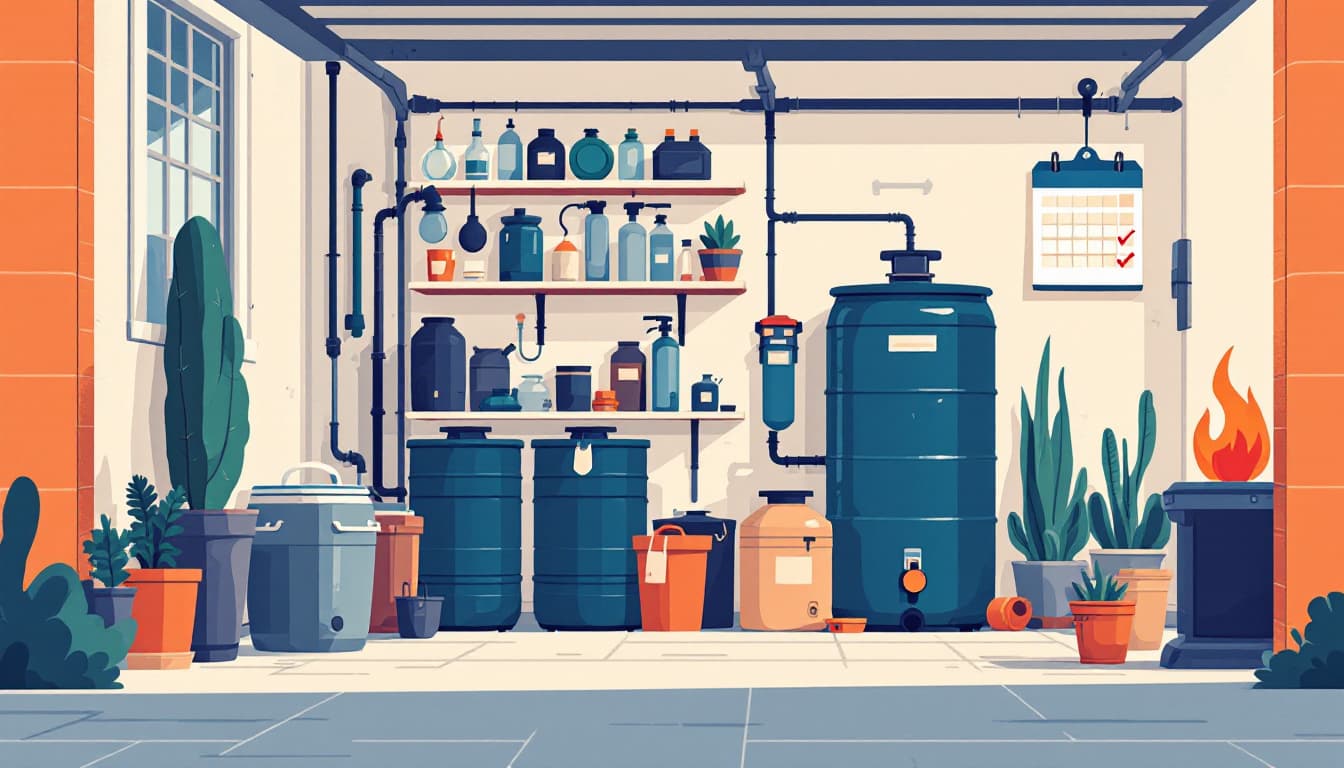
Start with 14 gallons per person, stored at home. FEMA's standard guidance is one gallon per person per day for 72 hours. That's a floor, not a plan. In Arizona summers, water needs during a grid disruption run higher — heat stress, no evaporative cooling, increased perspiration. Two gallons per person per day for a week is a more honest target. A family of four needs roughly 56 gallons on hand. Stackable 5-gallon food-grade containers from any hardware store cost less than $15 each and take up less floor space than a case of beer.
Know your utility's contingency tier. Both the Salt River Project service area and Tucson Water publish drought contingency plans. Call your city's water department and ask what Stage 1 and Stage 2 restrictions actually prohibit in your service area. The answer is usually available online, but calling confirms you have the current version. Knowing what gets cut first — outdoor irrigation, car washing, or something else — tells you where to reduce voluntary use now and avoid a scramble later.
Install a water filter rated for sediment and bacteria, not just taste. When municipal systems switch supply sources quickly — which is exactly what this new pipeline enables them to do — sediment and pressure changes can temporarily affect water quality. A countertop filter with a ceramic or hollow-fiber element handles that. It costs under $50. This is not a doomsday item; it's a reasonable hedge for a state that moves water across hundreds of miles of aging infrastructure.
Learn where your main shutoff is and test it. A pipe failure inside your home or at the meter is statistically far more likely than a municipal supply crisis. If you don't know where your shutoff valve is, find it this week. If it hasn't been turned in years, turn it partway now so you know it moves. A stuck valve during a burst pipe is its own emergency.
Track Lake Mead elevation once a quarter. The Bureau of Reclamation publishes current and historical elevation data. The Tier 1 shortage level — the threshold that triggers mandatory cuts to Arizona's allocation — is a specific elevation number, publicly available. Checking it four times a year takes five minutes and gives you more signal than any amount of general drought coverage.
The azcentral.com report is a reminder that Arizona has been playing a long game with water for fifty years, and the state's water managers are not asleep. The infrastructure is getting better. Your household resilience, though, is not something the Maricopa County Water District can provide for you. It requires a few inexpensive decisions made before the problem arrives.
A state that banks water in good years to spend in bad ones is modeling exactly what a prepared household should do. The infrastructure is not the ceiling — it's the baseline.