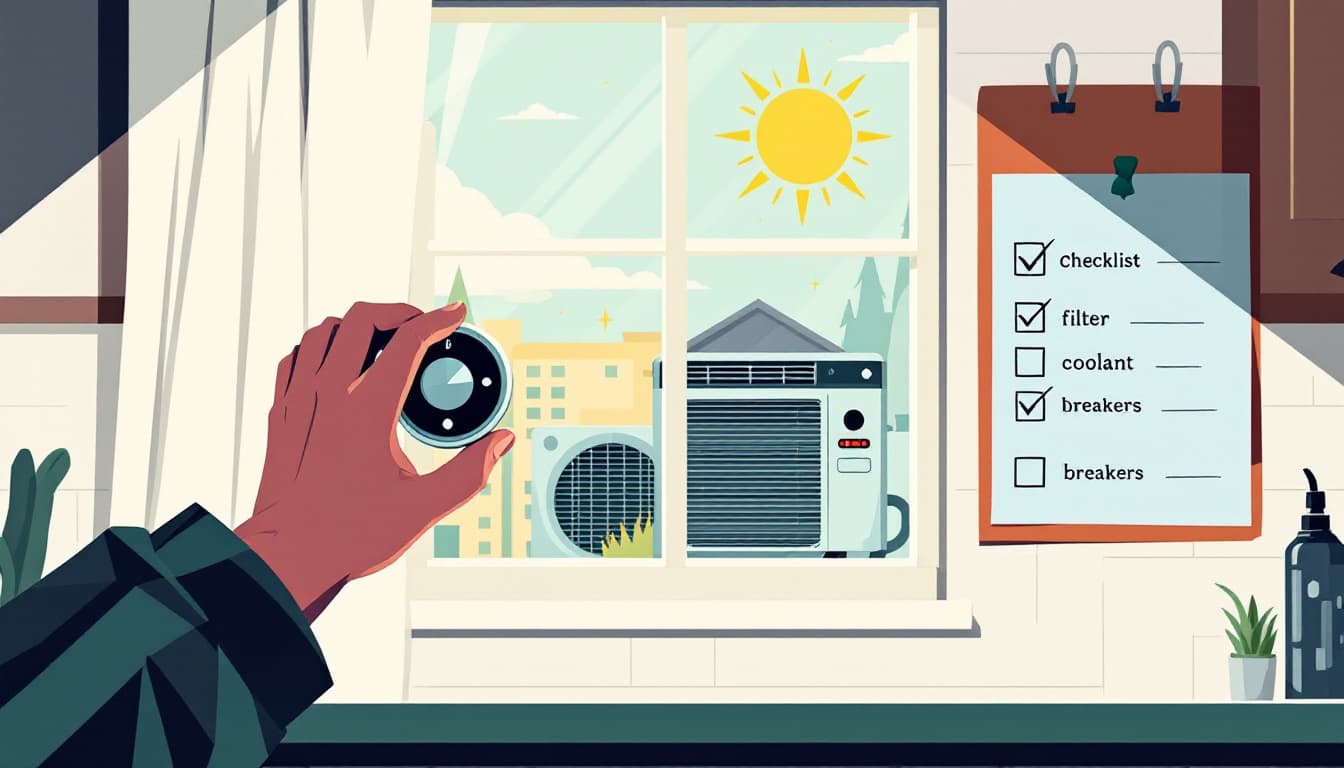
A KGUN 9 report this week flagged simultaneous gusty wind and extreme heat warnings across southern Arizona. Those two hazards get treated separately in most emergency guidance, but households should think about them together, because they interact in ways that tighten your margin for error fast.
What's actually happening
Extreme heat in Arizona is not news. What makes the current pattern worth a second look is the wind component. Gusty conditions during a heat event do several things at once: they accelerate evaporative cooling on the human body, which sounds helpful until you realize outdoor temperatures are already high enough that the math stops working around 105°F. More concretely, wind loads stress power infrastructure. APS and SRP both track what they call "weather-related outages," and the combination of high demand from air conditioning plus physical stress on lines from wind gusts is one of the more reliable ways Phoenix metro and Tucson households lose power in June.
Wind also moves dust. The Sonoran Desert generates haboobs that can drop visibility to near zero in minutes. A dust wall moving into a metro area during an extreme heat warning is not a dramatic edge case — it is a documented annual pattern along the I-10 corridor from Casa Grande to Phoenix and down through the San Pedro Valley.
The practical consequence: you may be managing an air quality problem, a power problem, and a heat problem at the same time, during a period when outdoor work or travel becomes genuinely dangerous.
What we'd actually do
Check your home's thermal mass before the next warning, not during it. A well-sealed Arizona home takes several hours to heat up after a power loss. A poorly insulated one — common in older Tucson rentals and some 1980s-era Maricopa County subdivisions — can reach dangerous interior temperatures within 90 minutes. Close interior doors, note which rooms stay coolest, and identify that room now as your household's fallback space. It costs nothing.
Fill your car's gas tank and your water storage above the halfway mark this week. During extended outages in Phoenix and Tucson metro areas, gas stations lose power too, and lines form within hours. AAA data consistently shows fuel-related service calls spike during extreme weather events. You want at least a half tank at all times during heat season. On water: FEMA recommends one gallon per person per day as a floor; in Arizona summer conditions — especially if you're sheltering without air conditioning — that number should be closer to two gallons per person per day. A case of bottled water is not a water plan. A few filled, food-grade containers stored in a cool interior closet is closer to one.
Tape a wet towel to a north-facing window before leaving for work on high-risk days. This sounds low-tech because it is. Evaporative cooling on glass can reduce radiant heat gain on that surface measurably during the hottest afternoon hours, particularly relevant if you have west- or south-facing rooms with older single-pane windows. It costs nothing and takes 45 seconds.
Know your nearest cooling center before you need it. Maricopa County operates a network of cooling centers that open automatically when the National Weather Service issues an Excessive Heat Warning — not just a watch. Pima County runs a similar system. The Maricopa County website maintains a real-time map. Save that URL in your phone contacts under "Cooling Centers" today. If your household includes elderly relatives, people with cardiovascular conditions, or anyone without reliable AC, knowing the nearest location is not optional preparedness — it is basic household safety planning.
Prepare for dust, not just heat. Keep an N95 or KN95 mask in your car's glove box. During a haboob, particulate matter can spike to levels that are genuinely harmful in under ten minutes of outdoor exposure. Arizona's Department of Health Services tracks dust-related respiratory hospitalizations each monsoon season, and the numbers are not trivial. The mask you already own from recent years costs nothing to relocate.
The bigger picture
Arizona households have always negotiated summer heat. What changes the calculus is compounding: wind plus heat plus a power grid under maximum load, possibly plus dust, possibly plus a household member with a medical condition. No single one of those is a catastrophe. Together, without a few hours of preparation behind you, they can become a serious household emergency.
Durability in extreme heat country is not about having a bunker. It is about knowing your house, knowing your neighborhood's infrastructure vulnerabilities, and making sure you are never caught with an empty tank and an empty closet when the temperature hits 115°F and the power goes out.