Brunswick County is in extreme drought. The Wilmington Star-News reported this week that local water managers are watching reservoir and aquifer levels closely, trying to calculate what combination of rainfall and reduced demand could pull the county back from the edge. They don't have a clean answer yet.
That's not a Brunswick-only problem. The NC Drought Management Advisory Council's monitoring maps have shown significant portions of the state's coastal plain and piedmont under drought watches or warnings throughout this summer. Brunswick just hit the threshold that makes it impossible to ignore.
What's actually different about extreme drought designation
A drought watch is a planning signal. Extreme drought is an operational one. At this stage, municipalities are weighing mandatory outdoor water restrictions, and private well owners — about 30 percent of North Carolina households rely on private wells, according to state environmental health data — start seeing reduced yield or complete pump failures as shallow aquifers drop.
The coastal plain geology compounds this. Much of Brunswick County draws from surficial aquifers that recharge relatively quickly after significant rain but also deplete quickly during sustained dry periods. A single good tropical system could shift conditions fast. It could also not arrive before September. Neither outcome is certain, and water managers are honest about that uncertainty.
The piece in the Star-News focuses on what it would take at the watershed and utility scale to ease conditions. That's the right question for county commissioners. It's the wrong frame for a family trying to decide what to do this week.
What we'd actually do
Establish your baseline water use before any restrictions are announced. Pull your last two utility bills and calculate your household's daily gallon average. Most families have no idea what their normal consumption is, which makes any mandated reduction feel arbitrary and hard to hit. Knowing your number gives you a target. Brunswick County Water Utilities and neighboring Brunswick Regional Water and Sewer have usage data available through customer accounts.
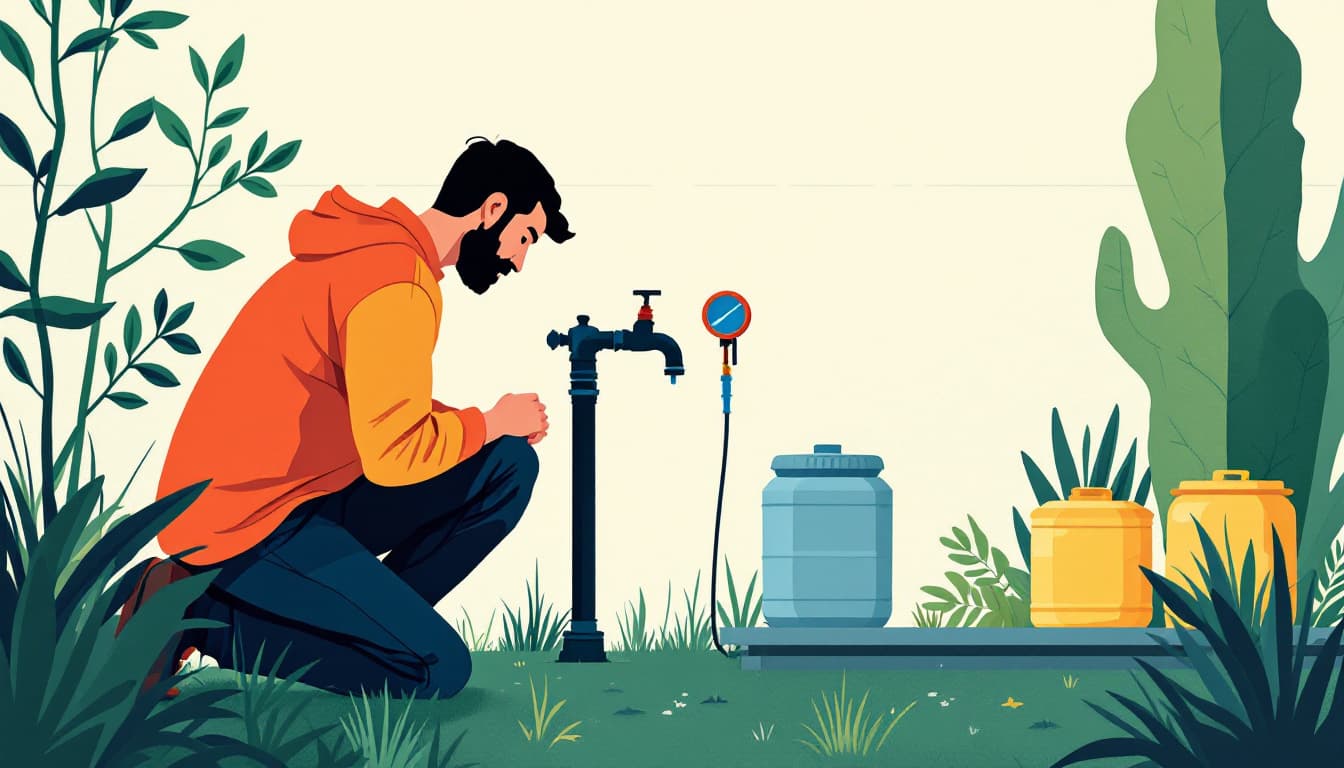
If you're on a private well, get your pressure tank and pump checked now, not when the yield drops. Well contractors in the Cape Fear region are already booking out. A pump pulling from a declining water table works harder, runs hotter, and can burn out without warning. A service call that costs a few hundred dollars now is cheaper than an emergency replacement during peak demand when crews are stretched. If your well was drilled before 1990, ask your contractor about its construction depth — older shallow completions are the most vulnerable.
Store a realistic short-term water supply. The standard emergency guidance is one gallon per person per day for drinking and sanitation. That's a survival floor, not a comfortable floor. For a family of four, a two-week supply is 56 gallons minimum — achievable with four or five food-grade 15-gallon containers stored in a cool interior space. This isn't about preparing for a collapse. It's about not needing to drive somewhere if a boil advisory or pressure failure hits your street for 48 hours.
Identify your highest-volume water uses and find one you can cut without lifestyle disruption. For most households it's irrigation. If you have in-ground irrigation, switch to a drought mode schedule or turn it off entirely. Lawn grass in coastal Carolina will go dormant and recover. Your landscape won't die in a week. This also matters practically: if restrictions come, outdoor irrigation is always the first thing banned.
Call Brunswick County or your municipality's public water authority and ask directly what Stage the current drought response plan is in. Most NC utilities have tiered drought response plans — Stage 1 through 3 or 4 — with specific triggers and restrictions at each level. Knowing where your utility sits right now tells you how much lead time you have before voluntary becomes mandatory.
The bigger picture
Drought in coastal North Carolina has historically been seen as a temporary inconvenience — something a tropical storm fixes. That mental model isn't wrong, but it creates a planning gap. Families wait for rain instead of building any water resilience at all. The result is that the first time a real restriction lands, it lands hard.
None of the actions above require significant money or a prepper identity. They require paying attention to a system most households take completely for granted until it doesn't work. Brunswick County is giving you the lead time. Use it.