A report this week from KESQ covered an Extreme Heat Warning issued by the National Weather Service office in San Diego at 9:49 PM PDT on August 7, running through 8:00 PM PDT on August 9. That's a roughly 46-hour window of officially dangerous temperatures across inland Southern California — the Coachella Valley, the deserts east of San Diego, and surrounding communities where daytime highs can exceed 110°F during events like this one.
Forty-six hours is not a weekend inconvenience. It's long enough for a household's cooling strategy to fail, for a vulnerable family member to decline without anyone noticing, and for the power grid to strain under aggregate demand in ways that produce localized outages at exactly the wrong time.
What actually happens during a multi-day extreme heat event
The risk profile changes on day two. On day one, indoor temperatures in homes without central air conditioning rise but are still manageable if the house started cool. On day two, thermal mass catches up — walls, floors, and furniture that absorbed heat overnight continue radiating it back even after outdoor temperatures momentarily drop. Nighttime lows during desert heat events often stay above 85°F, which means no passive recovery. A house that was 78°F inside on Thursday morning may be 88°F by Friday afternoon regardless of what the thermostat says.
California's grid operator, CAISO, routinely issues Flex Alerts during sustained heat — asking households to reduce electricity use between roughly 4 and 9 PM. That request is voluntary, but it signals real supply pressure. In 2020 and again in 2022, rotating outages followed sustained high demand during multi-day heat events across the state. That precedent is worth holding in mind.
Heat illness also compounds. Heat exhaustion can progress to heat stroke in under an hour, and heat stroke is a medical emergency with a mortality rate that rises sharply when emergency response times lengthen — which they do during regional heat events, when call volumes spike.
What we'd actually do
Identify your household's most vulnerable person and plan your day around them, not around your schedule. Infants, adults over 65, people on diuretics, beta blockers, or antipsychotics, and anyone with cardiovascular or kidney disease are at elevated risk. If that person is in your household, plan for them to be in air-conditioned space — yours or a public cooling center — from late morning through evening on both days. California counties publish cooling center locations through their Office of Emergency Services websites; Los Angeles, San Bernardino, Riverside, and San Diego counties all maintain searchable lists.
Set your AC to pre-cool the house by 9 AM. Grid demand peaks mid-to-late afternoon. If you push your home to its coolest practical temperature before 10 AM, you reduce how hard the system has to work during peak hours — and you build a thermal buffer that buys time if power wavers. Target 74°F or lower if your system can reach it.
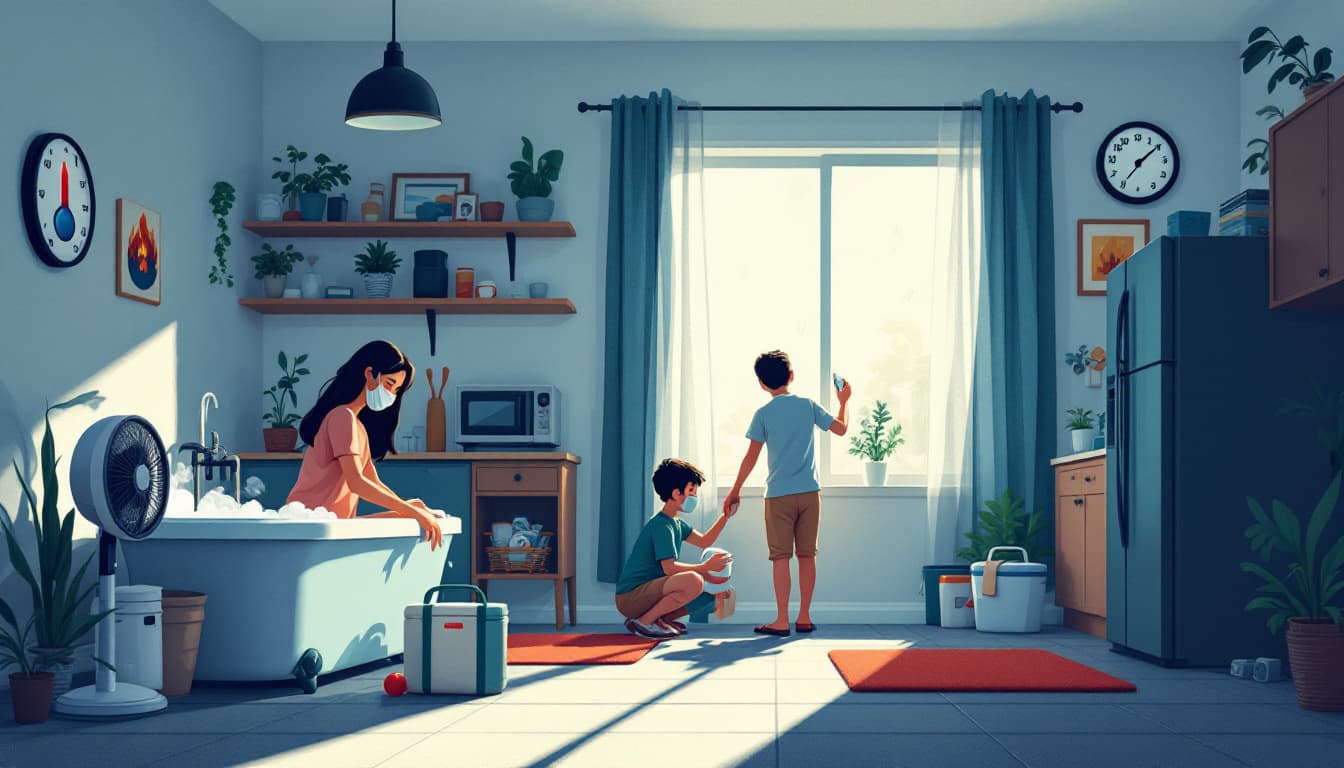
Fill your bathtub with cold water before any outage risk window opens. This costs nothing. If power goes out and your AC stops, a tub of cold water gives you a rapid cooling option — wet towels on the neck and wrists, a cool soak — that works without electricity. It also gives you a water reserve if supply pressure affects your municipality, which is uncommon but not unheard of during regional emergencies.
Check on neighbors who live alone, especially in older apartment buildings without central air. Apartment stock built before the 1990s in California's inland valleys frequently lacks whole-unit cooling. A five-minute check — a knock, a text — is the kind of household-level mutual aid that actually reduces heat mortality during events like this. Los Angeles County's heat mortality data consistently shows that social isolation is one of the strongest predictors of dying alone in a hot apartment.
Don't rely on fans above 95°F. Fans work by evaporating sweat. Above roughly 95°F ambient temperature, a fan blows hot air and can accelerate fluid loss without providing meaningful cooling. If your indoor temperature climbs into that range, fans become counterproductive. The action threshold is leaving the space, not adjusting the fan speed.
The bigger picture
California households in the inland deserts, the Central Valley, and the foothills will face more events like this one — that's not alarmism, it's what recent climate trend data from NOAA shows for Western North America. The goal isn't to build a bunker. It's to make your household structurally less dependent on everything going right simultaneously: the grid staying up, the AC not failing, the neighbor being fine.
A durable household handles a 46-hour heat warning as a managed inconvenience, not a crisis. That requires a little forethought on day one, before the heat peaks.