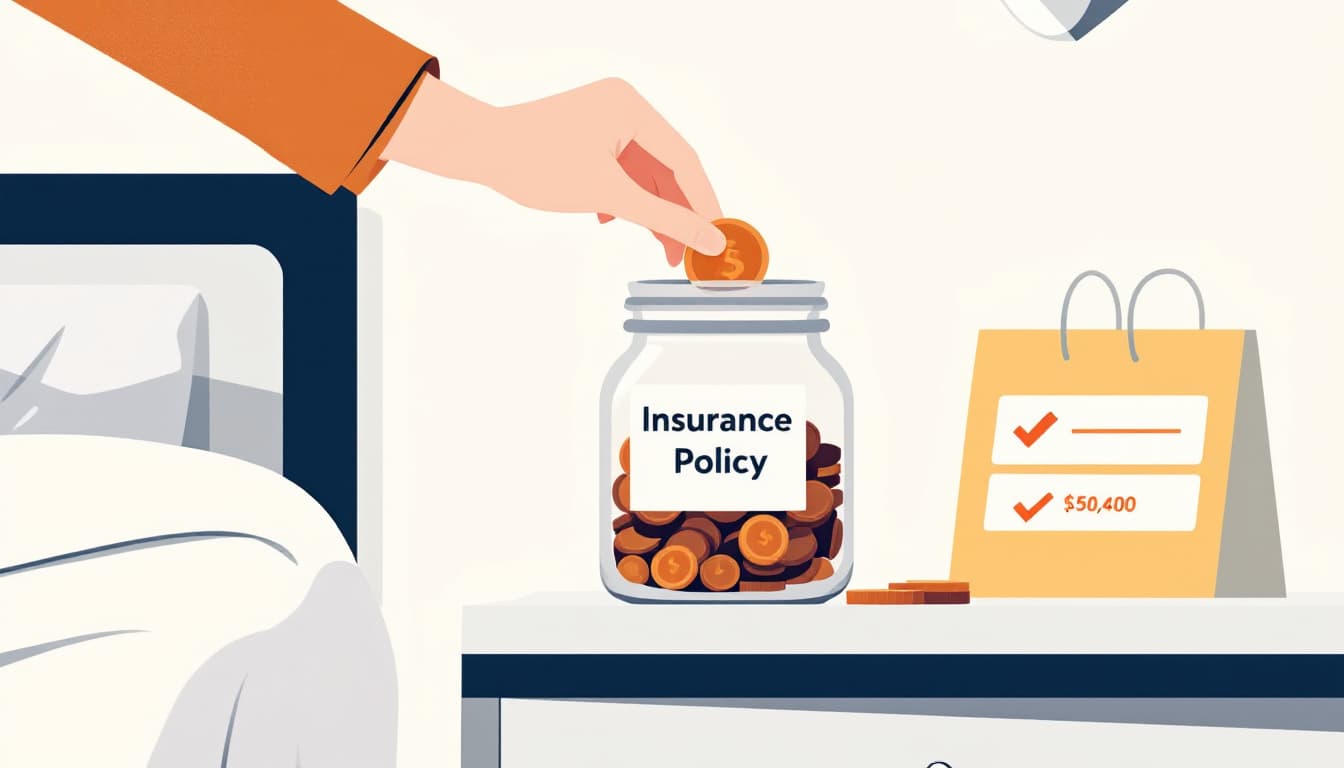
A family in suburban Columbus replaces their roof after a hail storm. They have homeowner's insurance. They feel prepared. Then the adjuster calls with a number — $4,200 — which is the deductible they agreed to three years ago when they picked the cheapest monthly premium they could find. The family does not have $4,200 liquid. They put it on a credit card. The card carries 24% APR. The "insurance" that was supposed to protect them becomes a debt event.
This is not a story about bad luck. It is a story about a category confusion that affects a significant share of middle-class households.
The framework: deductibles are self-insurance
Every deductible you carry — health, auto, home, renters — is an amount of risk you have formally agreed to absorb yourself. The insurance company is explicit about this. The contract says so. But most households mentally file the deductible as a billing technicality rather than as a specific dollar amount they have personally underwritten.
The practical consequence is that many families are simultaneously over-insured at the premium level and under-prepared at the deductible level. They pay monthly to transfer risk to an insurer, then cannot actually absorb the risk they contractually kept.
A resilience-lens reframe: your household's combined deductible exposure is a savings floor, not a coincidence. Add up every deductible across every active policy. For a two-car family with a home and standard health coverage, that total is often between $8,000 and $18,000. That number should sit somewhere visible. It is the minimum financial shock your household has agreed to absorb before the insurance actually starts functioning.
Why most people get this backwards
The standard advice — "build a three-to-six-month emergency fund" — is not wrong, but it is abstract in a way that lets people procrastinate. "Three months of expenses" is a moving target that always feels far away. It also doesn't map cleanly to the actual risk structure of a household's life.
Deductibles are concrete. They are already written down. They are the number that shows up in a real emergency, on a real timeline, before any other financial question gets answered. A family that can cover its combined deductible exposure without borrowing has cleared the most common financial failure mode of a property or medical event — not the catastrophic one, but the ordinary, happens-every-decade one.
There is also a second-order benefit. Once you know your deductible exposure precisely, you can make a genuine cost-benefit calculation about your premiums. A higher deductible lowers your monthly cost — but only makes sense if you can actually fund the difference. Most households who chose a high deductible to save on premiums never funded the gap. The premium savings went into the general household current and evaporated. This is not a character flaw; it is a design flaw in how the decision was presented to them.
What to do this week
Step one: pull every active policy and write down each deductible. Health (including any per-person family cap), auto for each vehicle, homeowner's or renter's, umbrella if you carry one. Add them up. Write the total somewhere you will see it.
Step two: compare that number to your actual liquid savings. Not your 401(k), not your home equity — money you could move to a checking account in 72 hours without penalty or debt.
Step three: if the gap is significant, open a dedicated account and label it clearly. Something like "deductible reserve" works better than a generic "emergency fund" label because the purpose is specific. Recent behavioral economics research consistently finds that mentally earmarked savings are harder to raid for non-emergencies. The label does real work.
Step four: fund it before you optimize anything else. Not after you max a Roth, not after you pay down the car note faster. The deductible exposure is a hole in your floor. Fill the floor before you work on the walls.
If the full amount takes time, triage by probability. Your auto deductible is statistically more likely to get triggered this year than your homeowner's. Fund the highest-probability exposures first.
The bigger picture
Preparedness orthodoxy tends to focus on unlikely extremes — grid failures, supply chain collapses, months of food storage. These are worth thinking about. But the financial event that actually derails a prepared household is almost always something mundane: a car accident in February, a burst pipe in March, a hospital stay in April. The insurance system was designed to handle exactly these events, but only if the household can absorb the first layer of cost without borrowing.
Treating your deductible as a savings target rather than a billing detail is not dramatic. It does not require a bunker or a freeze-drier. It requires a spreadsheet, one new savings account, and a realistic look at the contracts you are already signed into.
That is, in fact, most of what good household preparedness looks like.