A Louisiana First News report this week posted an updated forecast showing when residents can expect wildfire smoke to clear from the state's air. The headline is reassuring in the way weather forecasts always are — right up until the model shifts. The more useful question isn't when the smoke lifts. It's what you do with your household during the hours or days before it does.
Louisiana doesn't get much preparation credit for smoke events. Flooding, yes. Hurricanes, absolutely. But wildfire smoke drifting in from fires burning across Texas, the western Gulf Coast, or even as far as the central U.S. has become a recurring summer reality for parishes from Caddo to St. Tammany. The LDEQ (Louisiana Department of Environmental Quality) air quality index map now shows moderate-to-unhealthy readings during these events with enough regularity that treating each one as a surprise is a planning failure.
What's actually changing
The smoke affecting Louisiana during summer months isn't coming from a single dramatic local fire. It arrives as a regional drift — fine particulate matter (PM2.5) carried by upper-level winds from fires burning hundreds of miles away. That means the sky can look hazy or faintly orange even when there's no visible smoke source nearby, and many residents don't connect the haze to any health concern.
PM2.5 is the fraction that matters. Particles small enough to penetrate deep into lung tissue pass through standard HVAC filters and most basic face coverings. Children, elderly adults, and anyone with asthma, COPD, or cardiovascular conditions face the highest short-term risk. The CDC's guidance on PM2.5 exposure links even single-day spikes to increased emergency room visits for respiratory and cardiac events — that's not catastrophizing, it's the documented mechanism.
Louisiana's heat complicates the calculus. Keeping windows closed during a smoke event in July, when temperatures in Baton Rouge or Shreveport regularly exceed 95°F, creates its own health risk unless you have reliable air conditioning. Most households do, but power reliability in Louisiana during summer heat events is not guaranteed — and running the AC harder while sealing the house puts additional load on the grid.
What we'd actually do
Check LDEQ's AirNow map before opening windows in the morning, not just during an active forecast. Louisiana's air quality can shift overnight as smoke drifts on atmospheric currents. AirNow.gov pulls LDEQ sensor data and updates hourly. Making this a ten-second habit during July and August costs nothing and catches days when the sky looks clear but PM2.5 is already elevated. Set your zip code as a default.
Upgrade at least one room to MERV-13 filtration. Standard builder-grade HVAC filters (MERV-8 and below) do almost nothing for PM2.5. MERV-13 filters, which fit most standard residential systems, cost roughly $15–$25 each and meaningfully reduce fine particulate indoors during smoke events. Your HVAC contractor may say the increased resistance hurts your system — check the manufacturer specs for your air handler first, but most units built in the last 15 years tolerate MERV-13 without issue.
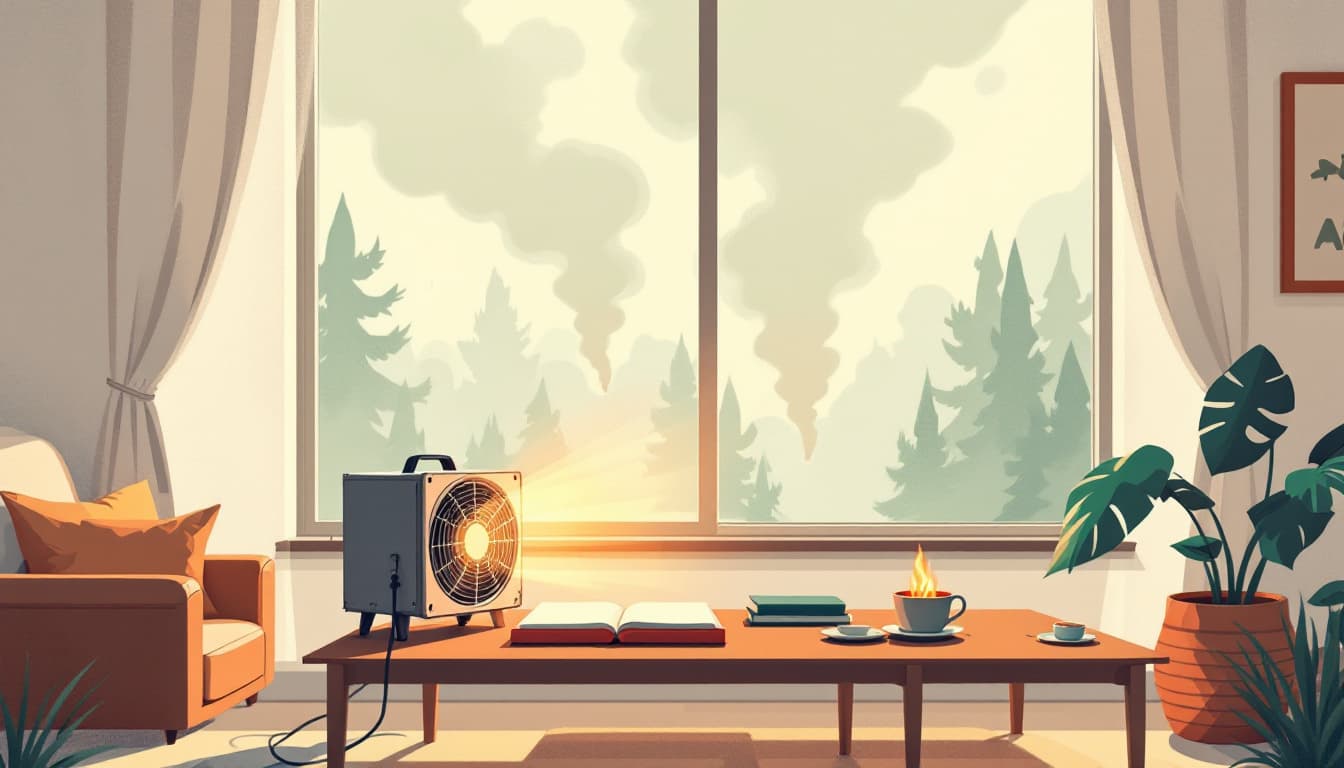
Build a single "clean room" if you can't filter the whole house. Pick one interior room, ideally with no exterior windows left cracked, and run a box fan with a MERV-13 furnace filter taped to the intake side facing the room. This DIY air cleaner — sometimes called a Corsi-Rosenthal box — can reduce PM2.5 in that room significantly for under $30. It's not elegant. It works. This is where young children and elderly family members should spend time during elevated smoke events.
Keep a week's worth of any respiratory medication on hand through October. Louisiana's smoke season tracks the broader Gulf and central U.S. wildfire season, which now runs from late spring through fall. Inhalers, nebulizer medication, and antihistamines go quickly at pharmacies during regional smoke events, and supply disruptions can compound a respiratory flare-up into a genuine emergency. Talk to your prescriber now, before you need an early refill.
Know your parish's cooling center locations. If a smoke event coincides with a power outage — not an unlikely combination in a Louisiana summer — your AC is gone, your windows need to stay closed, and the heat becomes dangerous fast. The Louisiana Department of Health maintains cooling center lists by parish during heat emergencies. Find yours now and save it in your phone; the websites can be slow to load when everyone is searching at once.
A smoke forecast with a timeline is useful. It tells you when relief is coming. It doesn't tell you that your house is sealed well enough to protect the hours before it does. Louisiana households already manage hurricane season, flood season, and heat season as overlapping realities. Smoke season belongs on that same list — not as a cause for panic, but as a condition that rewards a small amount of preparation done ahead of time rather than during.
Durability means you're not making decisions in a crisis that you could have made on a Tuesday when everything was fine.