A WXII forecast published this week puts North Carolina households on notice: the comfortable humidity of Thursday gives way to a heat wave beginning this weekend, with a rain and severe weather window arriving Saturday before the heat locks back in. That sequence — a brief severe storm followed by sustained high heat — is the combination that knocks out power and keeps it out while temperatures keep climbing.
This is not a drill-season hypothetical. It is a specific, near-term window in which a few hours of preparation now have measurable value.
What's actually changing
The pattern WXII is describing is common in the North Carolina Piedmont and Foothills in late June: a frontal system with storm risk on the leading edge, followed by high pressure that parks over the Southeast and drives afternoon highs into the mid-to-upper 90s, with heat indices that can push well past 100°F along the I-85 corridor from Charlotte to Greensboro.
What makes this dangerous is not the peak number on a thermometer. It's duration. Heat-related illness accelerates when nighttime temperatures stay above 75°F and indoor spaces that were tolerable at 9 p.m. become dangerous by 2 a.m. Older homes in Winston-Salem, Durham, and the rural Piedmont often carry that heat into the overnight hours — especially upper floors and mobile homes, which are significant in North Carolina's housing stock.
The Saturday storm risk adds a second layer. Duke Energy and Dominion Energy North Carolina both operate in the state, and their outage restoration timelines after a severe convective event in summer heat are measured in days for widespread damage, not hours. The North Carolina Department of Public Safety has historically activated county emergency management resources for heat-health threats, but shelter-in-place remains the first line of defense for most households.
What we'd actually do
Pre-cool your home Thursday and Friday, before the heat arrives. Running central air to bring interior temperatures down to 68–70°F before Saturday costs less in electricity and less strain on your unit than trying to recover from 85°F indoors after the wave hits. If your system is struggling now, schedule service before the weekend or call Friday morning — HVAC technicians in the Triad and Charlotte metro book out fast once temperatures spike.
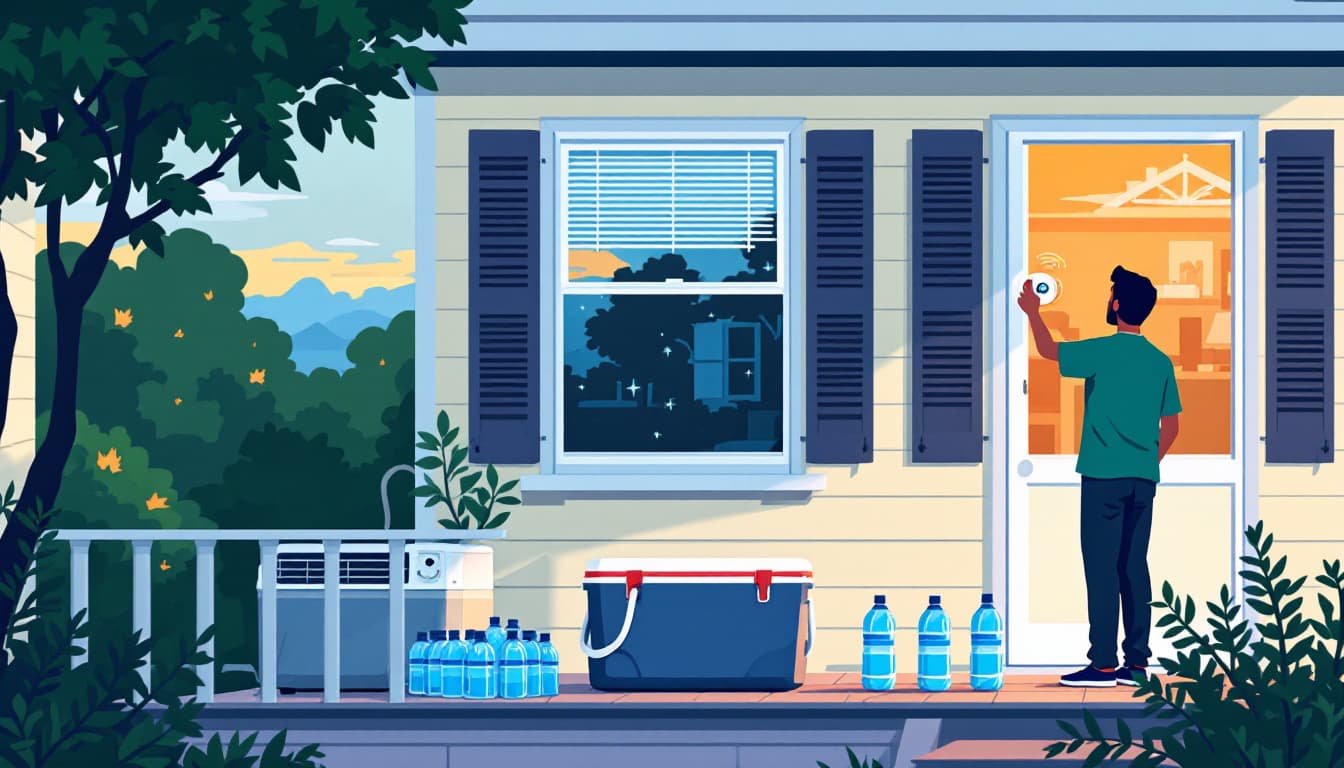
Fill your freezer with water bottles today. This costs nothing if you have plastic bottles around the house. A full freezer maintains temperature roughly twice as long as a half-empty one during an outage. Frozen water bottles also become portable cooling packs for people and pets. Aim to fill any unused freezer space before Saturday.
Identify your nearest cooling center before you need it. North Carolina counties activate cooling centers during heat emergencies — often at libraries, community centers, and fire stations. Look up your county's emergency management page (search "[your county] NC emergency management heat") or bookmark the NC 211 resource line now. Do this while you have power and connectivity, not after you've lost both.
Check on neighbors who are elderly, live alone, or lack reliable AC. Mecklenburg County's heat-related mortality data, like that from most NC metro counties, consistently shows that isolated older adults are the highest-risk group. A 10-minute check-in Thursday or Friday costs nothing and can be the difference between a close call and a tragedy.
Prepare a power-outage kit specific to heat. This is different from a winter outage kit. It should include: a battery-powered or hand-crank fan, a cooler and ice plan (know which nearby gas stations or grocery stores are likely to have bag ice), a list of medications that require refrigeration and the window of time they remain viable without it, and enough water for at least three days at one gallon per person per day. That last number is not arbitrary — it's the FEMA baseline and it's appropriate for a heat event where dehydration risk is elevated.
The bigger picture
North Carolina summers have always required heat planning. What changes over time is that heat waves that once lasted two or three days are stretching longer, and the state's grid faces increasing summer peak demand. Neither of those facts requires catastrophizing. They do require treating the next 72 hours as an actual planning window rather than background noise.
Durable households are not the ones with the most gear. They are the ones that acted on the Wednesday forecast before the Sunday outage. This weekend is a low-cost, high-return opportunity to find out how prepared yours actually is.