A Miami Herald report this week put South Florida's feels-like temperature at 110°F, triggering a heat advisory across the region. That number is not a record. It is, however, a useful forcing function — the kind of specific, named event that exposes whether your household's heat plan is real or theoretical.
Most Florida families have an air conditioner and consider themselves covered. That assumption deserves a closer look.
What's actually changing
Heat advisories in South Florida are not novel. What's shifted over the past decade is the clustering: longer consecutive-day streaks above advisory thresholds, nighttime lows that don't drop far enough for bodies to recover, and peak demand windows that strain the grid during the same hours families need cooling most.
Florida Power & Light and Duke Energy Florida both publish reliability data, and summer 2025 saw multiple high-demand alerts. When utilities ask customers to raise their thermostats voluntarily during peak hours — typically 4 to 9 p.m. — a household that has done no planning feels the difference immediately.
The other structural issue: Florida's housing stock. A significant share of homes in Miami-Dade, Broward, and Palm Beach counties are older construction with minimal insulation, single-pane windows, and flat or low-pitch roofs that absorb radiant heat. An AC unit working against a poorly sealed envelope runs harder, costs more, and is more likely to fail when it matters.
Finally, Florida's population skews older in many counties. Hillsborough, Pinellas, Sarasota, and Lee counties all have substantial populations over 65 — the group the CDC consistently identifies as most physiologically vulnerable to heat illness. If your household includes older adults, that changes your planning calculus.
What we'd actually do
Get a real baseline on your AC's condition before it fails under load. Schedule a filter change and coil cleaning if it hasn't happened this spring. A clogged filter can cut efficiency by 15% or more, which matters when the unit is running 12 hours straight. Most HVAC companies charge $75–$150 for a service call; that's cheaper than an emergency weekend call when the unit quits at 9 p.m. on a Thursday in August.
Map your household's vulnerable hours, not just vulnerable people. Think through who is home between noon and 6 p.m. — young children, elderly parents, anyone with cardiovascular or respiratory conditions. If a power outage hits during that window, you have roughly two hours before interior temperatures in a closed Florida home become dangerous in July. Know where your nearest cooling center is before you need it. Miami-Dade, Broward, and most other South Florida counties maintain cooling center locators through their emergency management websites; bookmark the page for your county now.
Build a four-hour power buffer for cooling. You don't need a whole-home generator to survive a short outage. A 20,000–30,000 BTU portable AC unit paired with a 2,000-watt portable generator or a large battery station (Jackery, EcoFlow, and similar units are now widely available at Costco and Home Depot) can hold one room to a survivable temperature. One sealed room is the goal — not whole-house comfort. Test the setup before you need it.
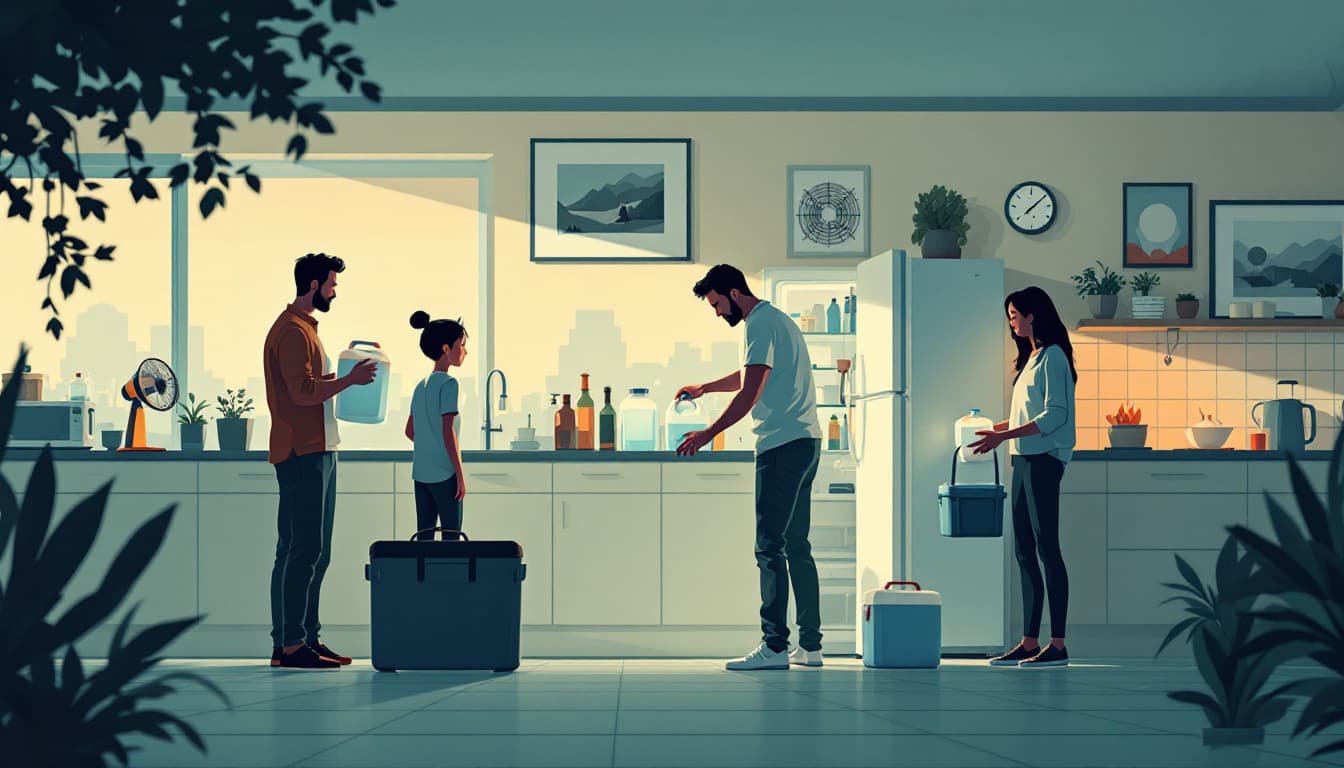
Treat your hydration supply like a grocery staple, not a crisis purchase. During a heat advisory, a physically active adult working outside or dealing with a home emergency needs two to four liters of water per day — more with exertion. A week's supply for a family of four is 56–112 liters. That's not a dramatic prepper cache; it's a reasonable pantry item for a Florida summer. Rotate it like anything else perishable.
Check on one person outside your household. Elderly neighbors, relatives who live alone, anyone who might not have reliable AC or who might be too proud to ask for help. The Florida Division of Emergency Management consistently reports that heat fatalities disproportionately affect people who died alone. A ten-minute check-in costs nothing.
The bigger picture
Florida households that manage heat well aren't the ones with the fanciest equipment. They're the ones that made a few unglamorous decisions in June — before the advisory, before the outage, before the ambulance. A 110-degree feels-like temperature is a reminder, not a catastrophe. Use it as one.
The goal isn't to build a bunker against the Florida summer. It's to be the household that stays functional and helps a neighbor when everyone else is scrambling.