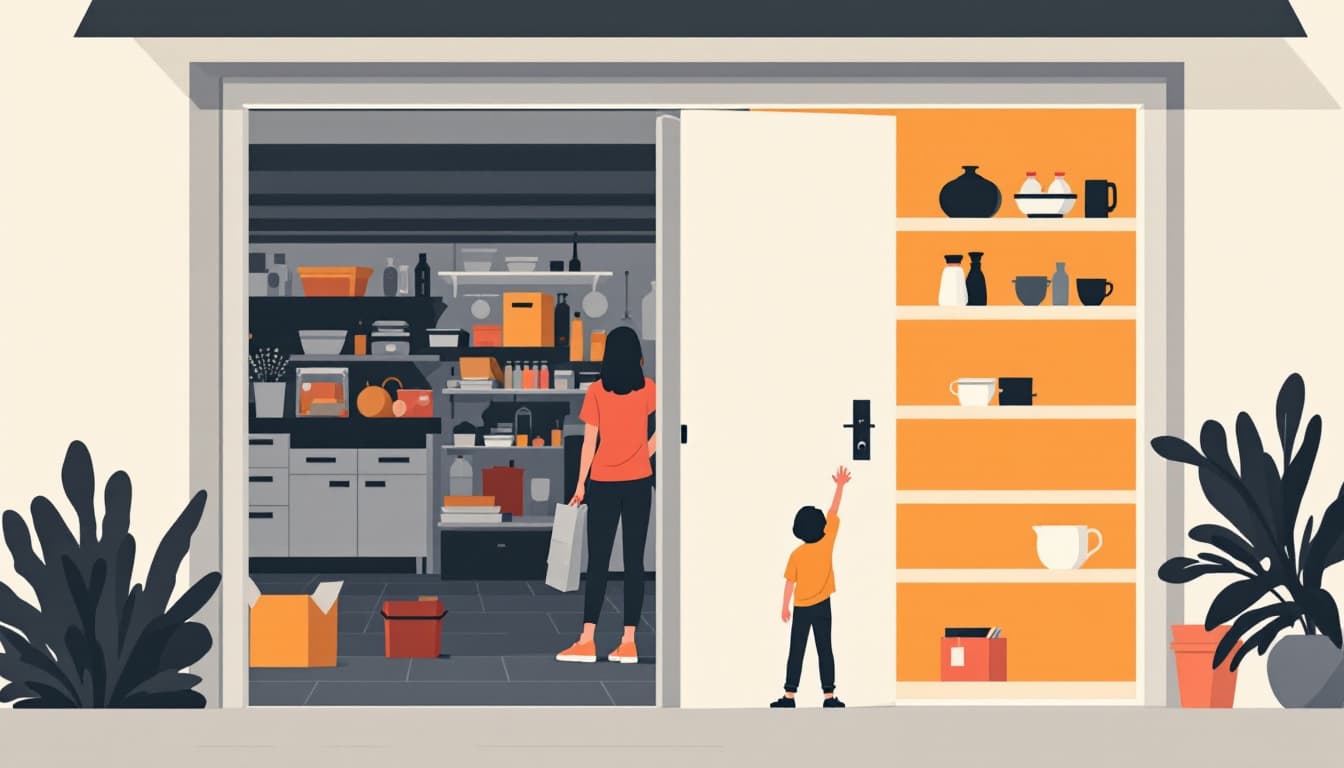
Picture two neighbors on the same cul-de-sac during a week-long ice storm. The first family — call them the Garcias — lost power on Tuesday and ate normally until Friday, ran their gas furnace on a backup battery, and returned to routine without drama. The second family had spent the previous two years assembling a basement full of Mylar-bagged grain, a diesel generator large enough to power a small restaurant, and a library of laminated field manuals. They also had $23,000 in credit card debt from buying it all, a marriage under quiet strain from the constant low-level argument about "how bad things could get," and — crucially — no working relationship with their neighbors, whom they regarded as potential threats.
The ice storm passed. Neither family suffered. But only one of them was actually better off for having prepared.
The real spectrum isn't prepared vs. unprepared
Preparedness culture tends to frame everything as a single axis: you're either ready or you're not. Buy more, store more, know more, and you slide toward safety. But that's the wrong model. The actual variable is durability — the capacity of a household to absorb unexpected costs (financial, logistical, social) without structural damage. And durability follows a curve, not a line.
Underprepared households are brittle. A single missed paycheck, a three-day power outage, or a car repair they didn't anticipate can cascade into real hardship. This is well-documented: recent Federal Reserve survey data consistently shows that a large minority of American households couldn't cover a modest unexpected expense without borrowing.
But over-prepared households — the ones optimizing for low-probability catastrophic scenarios — are brittle in a different and less-discussed way. They've concentrated resources (money, time, attention, social capital) into a narrow threat model. They're liquid-poor. They've often deferred ordinary financial resilience — the emergency fund, the diversified retirement contribution, the modest home maintenance reserve — in favor of specialized gear. When the actual disruption arrives, and it's almost never the disruption they planned for, they're no better positioned than their unprepared neighbors, and sometimes worse.
Why this is counterintuitive
The reason most people get this wrong is that preparedness content — including, we'll admit, some of ours — rewards specificity. It's satisfying to read about exactly which water filtration system to buy, exactly how many calories per person per day, exactly what a 72-hour bag should contain. Specificity feels like rigor. It feels like doing the work.
But the actual work of household resilience is mostly financial and social, not logistical. It's the three-month emergency fund. It's knowing your neighbors well enough to borrow a chainsaw or share a generator. It's maintaining vehicles and roofs before they fail. It's having adequate insurance with deductibles you could actually meet. These things are boring. They don't have good gear reviews. They don't generate the same sense of competence that assembling a tactical backpack does.
The durable households — the ones that genuinely weather disruptions — tend to share a particular disposition: they've thought seriously about the most likely bad things, not the worst possible bad things, and they've built capacity rather than inventory.
Capacity means optionality. A $10,000 emergency fund can handle a job loss, a medical bill, a furnace replacement, or a forced evacuation. Ten thousand dollars' worth of freeze-dried food handles exactly one scenario.
What to do this week
The following isn't a checklist for a specific threat. It's a calibration exercise.
Map your actual exposure. Write down the three disruptions most likely to affect your household in the next two years. For most middle-class families this will be something like: income interruption, major vehicle or appliance failure, and a health event. How prepared are you for each of those, specifically?
Calculate your liquid buffer. Add up money you could access within 72 hours without selling anything or incurring penalties. Divide by your monthly core expenses. If that number is below 1.0, that's your preparedness problem — not your water storage situation.
Inventory your social capital. Could you call two neighbors today and ask for a practical favor? If not, that's a preparedness gap worth addressing before you buy anything else.
Apply the 80/20 rule to your gear. Most households get 80% of their resilience benefit from the first 20% of preparedness spending: a few days of food and water, basic first aid, flashlights, and a charged power bank. Every dollar beyond that should be justified by a specific, realistic scenario — not a general feeling of anxiety.
The bigger picture
There's a philosopher's term — akrasia — for acting against your own better judgment. A lot of preparedness spending is akratic. People know, at some level, that their emergency fund matters more than their tactical flashlight collection. They buy the flashlight anyway because it feels like progress.
Genuine resilience is quieter than that. It looks like a family that is slightly less interesting to talk to at a preparedness forum, and slightly more able to handle whatever the next two years actually bring. The Garcias, back on that cul-de-sac, didn't have a fascinating basement. They had margin.
Margin is the product. Everything else is in service of it.