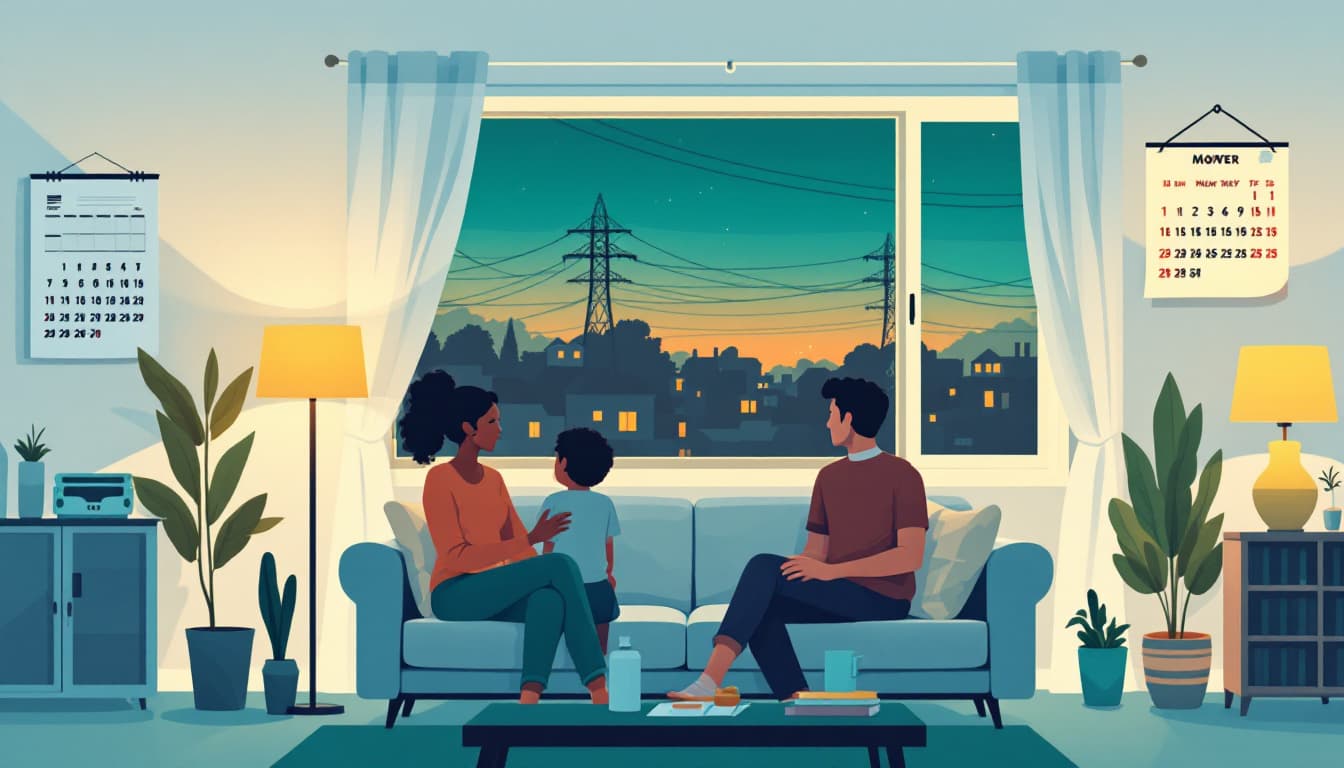
Somewhere in a suburban garage right now, there is a $4,000 whole-home generator sitting on a pallet, still in its shipping wrap, purchased two years ago for a grid collapse that arrived in a different shape than its owner expected. The power did go out — twice last winter, in fact. Both outages lasted under six hours.
That gap between the feared scenario and the actual one is worth examining carefully, because it is costing households real money and, more importantly, real attention.
The prepper community has spent the better part of two decades converging on a single nightmare: an extended, widespread grid failure — days or weeks, affecting large regions, triggered by a cyberattack, a geomagnetic storm, or cascading physical failure. The scenario has genuine intellectual pedigree. A small number of serious researchers have published credibly on grid vulnerability to extreme geomagnetic events, and infrastructure security is a legitimate policy concern. None of that is invented.
But the actual failure record of the U.S. grid tells a much more granular story.
Data from the Department of Energy's Electric Disturbance Events database, which utilities are required to report to, shows that the overwhelming majority of outage-minutes experienced by U.S. customers come from distribution-level failures — the wires between the substation and your house — not transmission-level collapse. A falling tree. An equipment fault on a neighborhood transformer. Ice on local lines. These events are geographically tiny and resolve in hours, not days. They are not glamorous. They are not the scenario that sells generators or moves prepper content.
The events that do produce regional-scale outages — major hurricanes, ice storms, the February 2021 Texas freeze — share a pattern that is also worth naming: they are almost never sudden and silent. They arrive with warning. People who lost power in the Texas freeze had days of forecast data telling them something serious was coming. The failure was in infrastructure design and political decisions about weatherization standards, not in a bolt-from-nowhere attack on the transmission backbone.
Here is the counterintuitive part: the total-collapse scenario is actually easier to prepare for conceptually than the real pattern, which is why it dominates prepper culture.
A total grid-down event has a clean narrative logic. Everyone is equally affected. Social order becomes the variable. Gear is the solution. You either have enough stored food and generation capacity or you don't.
The real pattern — short, local, somewhat frequent — requires something messier: calibrated, proportionate preparation that scales to the actual risk distribution. That means accepting that a 72-hour battery backup and a small inverter probably covers 95% of realistic outage scenarios for most U.S. households. It means acknowledging that your most likely "grid emergency" is a transformer failure on your street in January, not an EMP. It means the marginal value of your fifth day of diesel versus your first battery backup is very low.
This is not how anxiety works, and prepper culture is heavily shaped by anxiety. Big threats feel like they demand big responses. Small, frequent threats feel like they're already handled — even when they aren't, because nobody bought the small solution.
None of this means grid infrastructure is in perfect health. Aging equipment, increasing load from electrification, and the real complexity of integrating variable renewable sources create genuine maintenance challenges that utilities and regulators are actively working through. Extreme weather events — particularly heat domes and ice storms — are producing outages in places and seasons that hadn't historically seen them. These are real trends worth monitoring.
But monitoring a real trend is different from building your household's preparedness posture around a tail-risk scenario that, even in expert threat assessments, is genuinely rare and almost certainly would arrive with some warning.
The family that has a charged battery bank, a week of shelf-stable food, and a plan for a three-day outage is more prepared for the grid as it actually fails than the family with a whole-home generator and no batteries, whose preparation is tuned entirely to a scenario that remains, for most of the country, hypothetical.
Preparedness orthodoxy rewards dramatic threats. The grid collapse narrative has earned its place in that hall of fame. It just hasn't earned its place in your household budget.