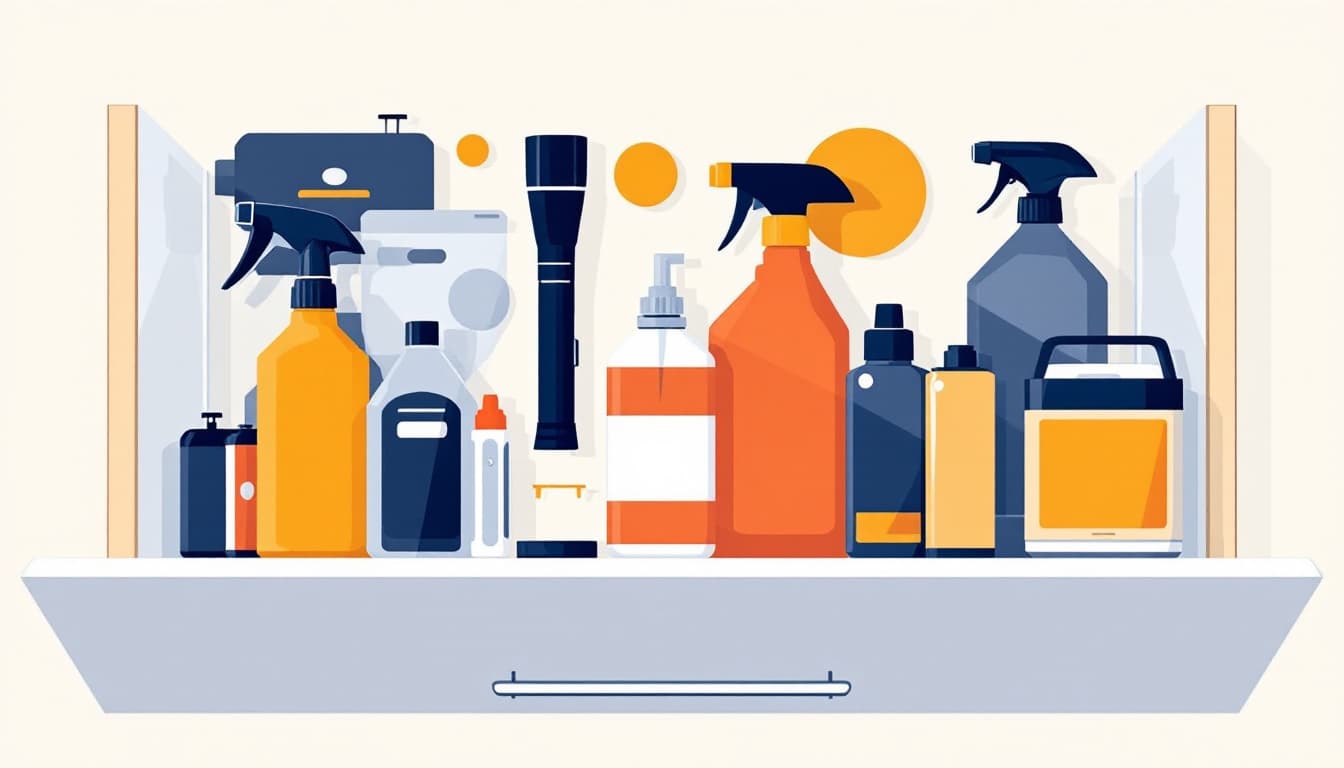
There is a drawer in a lot of well-run households that looks almost embarrassing. Two can openers. A backup phone charger still in the box. A second set of reading glasses in a zipper pouch. A spare house key on a hook that nobody uses. Nothing dramatic. Nothing that would photograph well for a social media preparedness post.
That drawer is, quietly, one of the most effective emergency preparations most families will ever make.
The pattern we keep seeing
Across a range of coverage — drought conditions straining municipal water systems, summer heat events stressing local power grids, supply chain volatility pushing grocery prices around — one pattern keeps surfacing when we ask what separates households that manage a disruption gracefully from those that scramble: it is almost never the dramatic gear. It is the presence of a functional second option for ordinary things.
Not a generator. A second flashlight. Not a rainwater cistern. A case of water under the stairs. Not a ham radio. A neighbor's phone number written on paper.
The pattern is redundancy. Quiet, boring, redundant systems applied to the things your household actually uses every day.
Why most people get this wrong
Preparedness culture — and we say this with some affection, because we live in it — has a theatrical bias. The imagery skews toward bunkers, Faraday cages, and 72-hour bags that weigh thirty-five pounds. This framing is not entirely useless, but it systematically undervalues the thing that helps most families in most real disruptions: having a functional second option for the systems they depend on hourly.
Consider what actually happens during a three-day power outage — the most common meaningful disruption for households in the continental U.S., according to utility industry data. Families do not need night-vision goggles. They need light, a way to charge a phone, food that does not require the stove, and the ability to communicate with one or two people outside the house. Those needs are almost entirely solved by boring redundancy: a working flashlight with fresh batteries, a charged backup battery, a cabinet of shelf-stable food, and a neighbor's number on paper.
The theatrical framing also has a cost problem. Dramatic gear is expensive and depreciates in relevance quickly. A $400 solar generator is a meaningful purchase; a second $12 flashlight and a $20 power bank are not. Most households have more room in their budget for the second category and derive more actual resilience from it.
There is also a maintenance gap. Dramatic gear requires active maintenance — fuel, charging cycles, skill practice. Boring redundancy mostly maintains itself. A second manual can opener does not need to be rotated.
What makes redundancy "household-level"
The useful version of this principle is not "own two of everything." It is more targeted than that. Ask: what are the five things my household uses or depends on every day, and what happens if the primary version of each one fails or becomes unavailable for 72 hours?
Work through that list concretely. Water from the tap. Heat or cooling. Lighting. Communication. Food preparation. For each one, a functional backup does not have to be elaborate — it has to exist and be reachable.
The version of this that fails is abstract stockpiling — buying cases of freeze-dried meals because they felt prudent, then discovering in a real event that you have no way to boil water. The version that works is tracing your actual daily dependency chain and inserting one redundant link at each critical point.
What to do this week
Pick the two daily dependencies in your household that have zero backup. Not the most dramatic ones — the most routine ones. Lighting is a common gap: many households have one working flashlight with uncertain batteries. Food preparation is another: a gas stove becomes inert in a power outage if you have no alternative heat source, and an electric stove does the same in a gas disruption.
For each gap you identify, find the smallest and cheapest functional redundancy. Two flashlights and a four-pack of batteries. A camp stove with two fuel canisters stored safely. A written list of three local contacts who could help in an emergency. A printed copy of your insurance policy's emergency line number.
Spend less than $50 total. Verify that the backup actually works before you put it away.
The bigger picture
The preparedness industry has a financial incentive to make you feel underequipped. The actual evidence — from FEMA after-action data, from utility resilience research, from the lived experience of households that navigate disruptions well — points the other direction. Most families are not underequipped with gear. They are underequipped with boring, functional redundancy in the systems they use every single day.
That drawer with two can openers is not embarrassing. It is the point.