
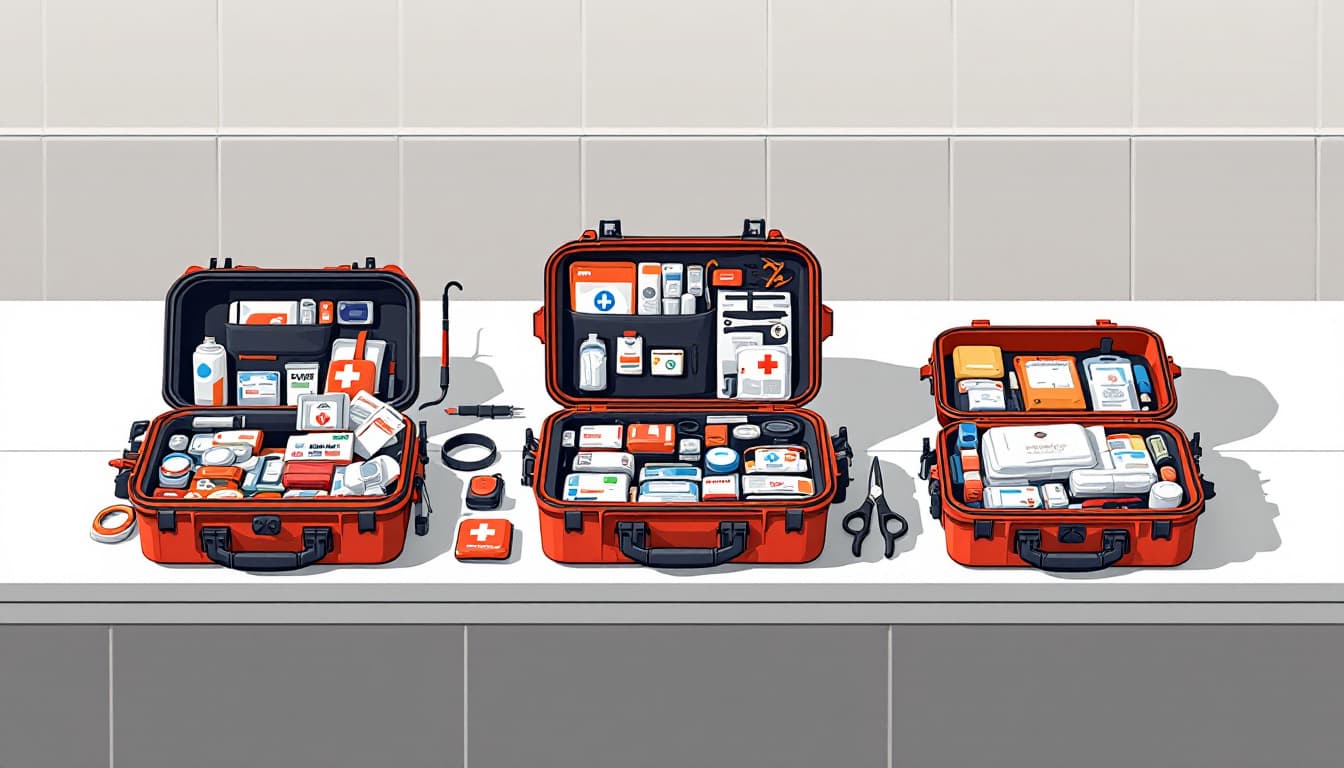
First aid is the preparedness category where households most often spend money badly. The Amazon top-seller chart for "first aid kit" is dominated by 200- and 300-piece kits that sound substantial — until you open them and realize three-quarters of the "pieces" are individually-wrapped band-aids and the gauze pads are the size of a postage stamp. Those kits are not engineered for emergencies; they're engineered to look full at unboxing.
The three picks above are engineered for actual use. They reflect a real medical decision the household has to make: an all-in-one kit that handles both everyday injuries and serious trauma (PRO), a comprehensive household kit that skips the trauma items most home users will never train to deploy (Standard), and a pure budget IFAK with a genuine CAT tourniquet for households that just want the bleeding-control tool by the front door.
How to think about kit selection
Most households we hear from want a single comprehensive kit. The honest answer is that "comprehensive" splits into two real questions: (1) Do you want full trauma capability, including tourniquet and hemostatic gauze? (2) Do you have someone in the household who'd be trained to use those items correctly under stress?
If the answer to both is yes, the MyFAK PRO is the right kit. Trauma + household first aid in one bag, one location, one inventory.
If the answer to (1) is yes but (2) is no, you have a different problem to solve. A tourniquet applied wrong can fail. A chest seal applied wrong can make a penetrating chest wound worse. The kit is only as useful as the training. We'd suggest: buy the MyFAK Standard ($150) for the household first-aid scenarios you actually deal with, then take a Stop The Bleed class (stopthebleed.org — free, 90 minutes, available nationwide), and only then add a trauma IFAK. The EVERLIT at $45 is the right add-on once the training is done.
If the answer to (1) is no — you just want a household kit for kitchen-knife cuts, sprains, burns, and minor injuries — the MyFAK Standard alone is the right answer. The trauma items in the PRO are not worth $135 of upgrade for a household that won't use them.
What the medical reality looks like
The household scenarios first aid actually gets used for, in roughly descending order of frequency:
Kitchen and tool cuts. Falls and bruises. Burns from the stove or grill. Splinters. Bee and wasp stings. Sprains from sports and play. Allergic reactions to food or medication. Cuts that need stitches but are bleeding manageably while you drive to urgent care.
The realistic scenarios that move from "first aid" to "trauma kit": catastrophic bleeding from a serious accident — a chainsaw injury, a car crash, a deep cut from a kitchen knife slipping into the femoral artery (it happens more than people think). A serious fall with internal injury. A penetrating injury. The kinds of events where the person is bleeding out and the question is whether they can make it 8-15 minutes until paramedics arrive.
A tourniquet and hemostatic gauze, used within 2-3 minutes of injury, change those outcomes. The Hartford Consensus — the joint civilian/military trauma response framework — is built around the data that uncontrolled hemorrhage is the leading preventable cause of trauma death, and that civilian bystanders with basic equipment can meaningfully intervene.
What we'd buy and why
If we were furnishing a household from scratch with a $200 budget, the buy order is:
- The MyFAK Standard, today, $150. It lives in the kitchen or bathroom and handles everything you'll realistically deal with in a year.
- The EVERLIT Emergency Trauma Kit, this month, $45. Mark it visibly, store it by the front door or in the entryway closet — somewhere any adult can grab in 5 seconds. Tell everyone in the household where it is.
- Stop The Bleed class for whichever adult in the house would be the one to use it. Free, 90 minutes. The training matters more than the kit.
If your budget allows $300+ and at least one household member is willing to take the training, the MyFAK PRO is the right single-kit answer. Same level of medical capability, one inventory to maintain, one storage location.
What we didn't recommend
The MyMedic Solo ($90) was on our 2025 pick list. It's still a fine kit. We moved off it this year because the MyFAK Standard at $150 is meaningfully more capable for $60 more — splint, EMT shears, burn gel, dedicated medication module, more wound-closure options. If you find the Solo discounted to $50-60, it's a credible budget alternative for the truly minimal household first-aid use case.
The North American Rescue IFAK-M Trauma Kit ($85) is the gold-standard trauma IFAK and what most professionals carry. We picked the EVERLIT over it at the budget tier specifically because EVERLIT includes the same authentic CAT GEN-7 tourniquet for half the price. NAR is the more-trusted brand and the right answer if you have $85 of trauma-kit budget; the EVERLIT is the right answer if you have $45 of trauma-kit budget. Either is meaningfully better than skipping the tourniquet entirely.
The Adventure Medical Kits Trauma Pak with QuikClot ($30) is a credible pocket-sized trauma supplement. We didn't include it because it lacks a tourniquet, which is the single most important hemorrhage-control tool. If you're spending $30 anyway, spend $45 and get the EVERLIT.
The CAT GEN-7 Tourniquet standalone ($30) is the right tourniquet but not the right purchase as a standalone — you also need hemostatic gauze and a pressure bandage, which is why the EVERLIT packaging makes more sense.
The larger NAR kits ($150+) are the right answer for fleet vehicles, rural ranches, and group operations, not for a typical household.
The Ready America 70383 and similar Amazon-top-seller kits with 200-300 "pieces" are not real first aid kits. Skip them.
A note on counterfeits
Counterfeit CAT tourniquets are a real problem on Amazon — fake silicone-band tourniquets sell under the CAT name with the wrong specifications and consistent failure-to-stop-bleeding patterns in user reports. Both the MyMedic kits and the EVERLIT specify they ship authentic CAT GEN-7 tourniquets, and both are sold-and-shipped-by-Amazon or by the brand directly. The combination of those two checks (authentic-spec claim + first-party seller) is what we look for. If you're buying tourniquet components separately, buy from North American Rescue directly to be safe.
How we researched these picks
We read every one-, two-, and three-star verified review on the top forty first aid and trauma kits on Amazon (roughly 2,900 reviews), pulled component-level specifications from each manufacturer, and cross-referenced against the Hartford Consensus and Stop The Bleed curriculum to verify which items actually appear in clinical guidance. We weighted heavily against any "trauma kit" that didn't include a real CAT-class tourniquet, and any "first aid kit" whose 1-star complaints clustered around "everything is tiny single-use packets."
We'll update this review when MyMedic refreshes the MyFAK line (rumored for late 2026) or if new hemostatic-gauze formulations reach the consumer market.

