
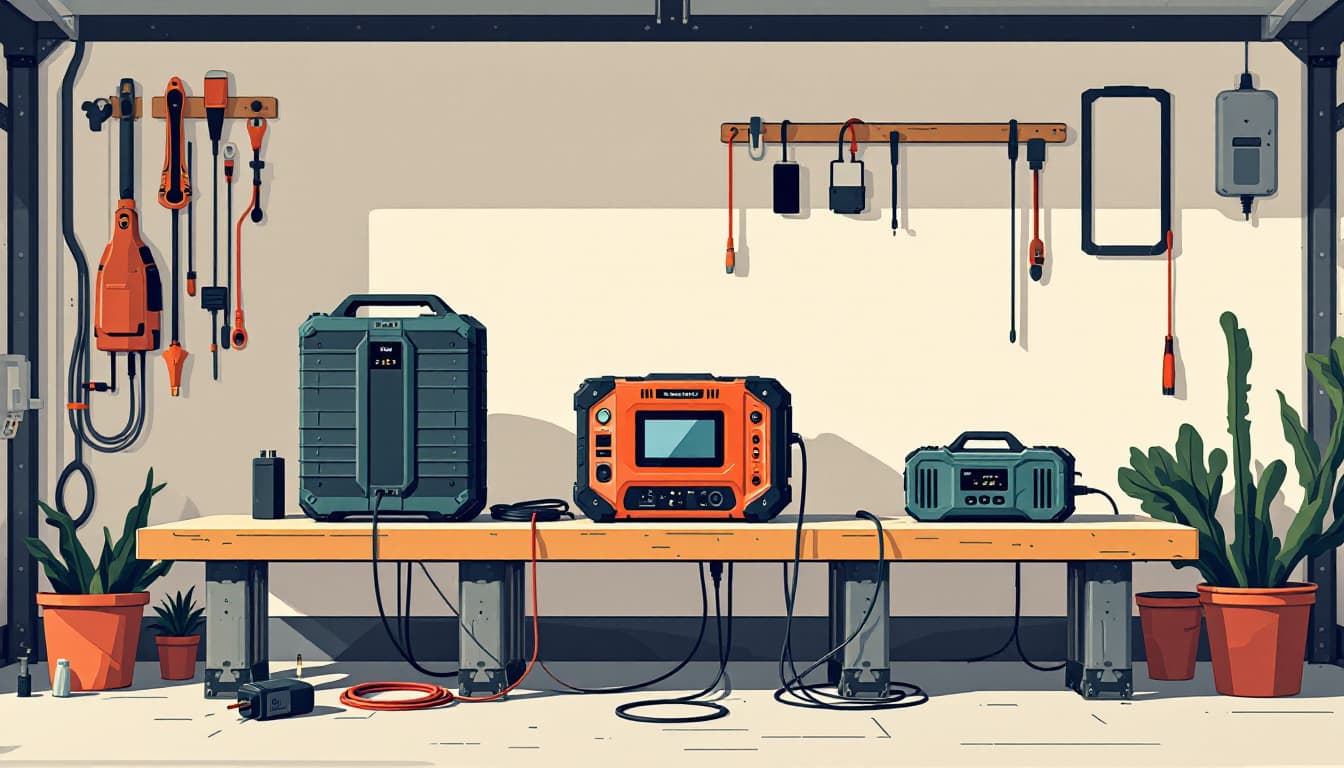
Portable power stations are the preparedness category where the household calculus has shifted hardest in the last 24 months. The 2024-2025 product cycle pushed LiFePO4 (lithium iron phosphate) chemistry into the budget tier — what used to be a premium-only feature is now standard. EcoFlow and Anker each refreshed their flagship lines with Gen 2 / Pro 3 hardware in the past 12 months, bringing faster charge speeds and true 120/240V split-phase output down into the sub-$2,500 segment.
The three picks above represent the three real household decisions in this category: a unit that handles whole-home backup including 240V circuits (DELTA Pro 3), a unit that handles a long-weekend outage and stays light enough to move around (Anker SOLIX C1000 Gen 2), and the proven, lowest-regret LFP entry point that costs less than the Anker but carries the most established service ecosystem (EcoFlow DELTA 2).
What the wattage numbers actually mean for a household
The three specs that matter are watt-hours of capacity, watts of AC output, and battery chemistry.
To make these abstract numbers concrete: a typical full-size refrigerator pulls about 100-150 watts averaged over its duty cycle, which means a 1,000Wh unit runs one for roughly 8-10 hours and a 4,000Wh unit runs one for 30-40 hours. A LED bulb pulls 8-10 watts; a CPAP machine pulls 30-60 watts; a phone charges at 5-10 watts. Microwaves and induction cooktops pull 800-1,500 watts when running, which is what kills smaller units — not capacity but the instantaneous AC output cap.
The most common mistake households make is buying for capacity when output is the actual constraint. A 2,000W AC output (the Anker SOLIX C1000 Gen 2) handles most household appliances. A 4,000W AC output (the DELTA Pro 3) handles split-phase 240V circuits — well pumps, EV chargers, central HVAC compressors, and electric clothes dryers.
The other spec that matters in 2026: battery chemistry. LiFePO4 (lithium iron phosphate) lasts 3,000+ charge cycles before meaningful capacity loss. NMC (nickel manganese cobalt) lasts about 500. At household use rates that's the difference between a decade of service and three or four years. All three picks here are LiFePO4. We do not recommend buying a new NMC unit in 2026 at any price.
Who actually needs what
The right unit depends on the scenario you're solving for.
For whole-home backup including 240V circuits. You want true split-phase output and at least 4,000Wh of capacity. The DELTA Pro 3 is the right answer. Expand to 8-16kWh of battery if you want multi-day coverage for the full house. This is the right tool if you own a well pump, an EV, central HVAC, or other 240V critical loads.
For multi-day grid outages of essential circuits only. A 1,000-2,000Wh unit handles a fridge cycling, lights running, phones and laptops, and a CPAP. The Anker SOLIX C1000 Gen 2 is the right answer at 1,024Wh; the DELTA 2 is the right answer at the same capacity for less money if Anker's faster charging isn't worth the $50 to you.
For weekend outages and camping crossover. Both the Anker and the EcoFlow DELTA 2 work well. The Anker's lighter weight and faster charging are nice for actual road-trip use; the EcoFlow's solar input is more capable. Pick by which use case you actually have.
For medical-device backup specifically. A CPAP pulls 30-60W and runs all night on essentially any modern power station. The DELTA 2 at 1,024Wh covers four nights without solar; the DELTA Pro 3 covers about 30. This is the cheapest preparedness lever per dollar for households with sleep-apnea or oxygen-concentrator needs.
What we'd buy and why
If we were furnishing a household from scratch with a $500 budget, the answer is the EcoFlow DELTA 2 and nothing else. It's not the most powerful unit on the list, but it's the unit that does the most use cases well — household backup, camping, road-trip, the occasional power-tool job in the driveway — and the 5-year warranty plus established service ecosystem makes it the lowest-regret purchase at this price point.
If the budget allows $450 for a single unit, the Anker SOLIX C1000 Gen 2 is the upgrade — same 1,024Wh capacity as the DELTA 2 but with faster charging and a lighter form factor. We picked it as the Value tier specifically because most households will use the speed and portability benefits more often than they'll use the DELTA 2's solar expandability.
If the budget allows $2,200+ and you have 240V household loads worth backing up, the DELTA Pro 3 is the right call. Not because the smaller units aren't enough for what they cover, but because the marginal cost of stepping up to true whole-home capability is meaningful, and split-phase backup is the kind of thing that gets cheaper to do incorrectly until the day a real outage tests the setup.
What we didn't recommend
The Bluetti AC200P ($1,699) was a category-defining product when it launched in 2020. It's still credible hardware but it's been outclassed: the Bluetti AC200PL (its successor) carries better output and expandability, and EcoFlow's DELTA 2 and DELTA Pro 3 cover the same use cases with newer firmware and more established service ecosystems. If you find the AC200P heavily discounted, it's not a bad buy — but at full retail there's no reason to choose it over the picks above.
The Goal Zero Yeti 500X ($500) was on our 2025 pick list as a budget option. We removed it this year because at $500 the Anker C1000 Gen 2 delivers double the capacity at LiFePO4 chemistry — meaningfully better hardware. Goal Zero's warranty support is still excellent, but the price-per-watt-hour math no longer works in their favor.
The Jackery Explorer 1000 ($999) is a perfectly fine product. We picked the EcoFlow DELTA 2 at the same price point because the LiFePO4 chemistry (vs Jackery's NMC), the faster AC charging, and the expandable battery option add up to more household longevity.
The Westinghouse iGen2200 inverter generator ($499) is a gas unit. It's louder, requires fuel storage, can't run indoors, and depreciates faster than a battery unit. The math used to favor gas; in 2026 it doesn't, except for jobsite-style continuous-use applications.
How we researched these picks
We read every one-, two-, and three-star verified review on the top 30 portable power stations in the 500-5,000Wh range (roughly 2,200 reviews). We pulled manufacturer-published spec sheets, ran them against independent capacity-test reports from RV-electronics testers and the credible YouTube reviewers who do real load testing (we excluded affiliate-only "unboxing" channels entirely). We cross-referenced reported real-world capacity against the 95th-percentile of 1-star complaints to identify which units consistently underperformed their specs.
The pattern of complaints across this category is informative: the most-common 1-star issues are idle drain (units losing 20-30% of their charge over a month when left unplugged), warranty support, and inverter quality (the AC output drifting from a clean sine wave under load). The picks above were chosen partly because those specific failure modes show up less frequently in the verified-purchase data.
We'll revisit this review in November when holiday-season pricing makes some of the units 30-40% off their stickers. If the rankings shift, we'll note the change with the date here.

