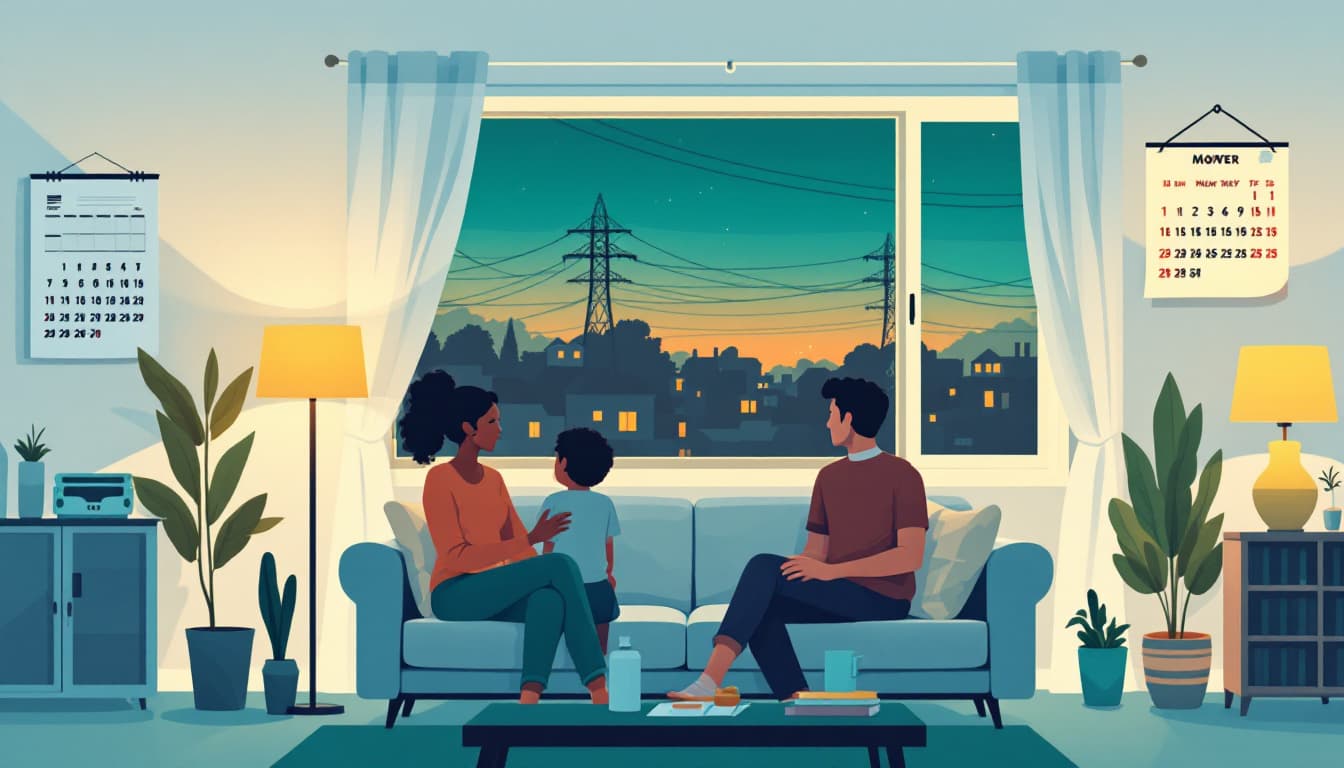
Picture the planning session in a thousand garage workshops right now: someone is calculating how many gallons of diesel will sustain a whole-house generator through a six-month grid collapse. The math is elaborate. The spreadsheet is color-coded. And the scenario driving all of it — a catastrophic, society-wide, months-long blackout — has roughly the same probability as a scenario that would also make the diesel irrelevant.
This is not an argument against owning a generator. It is an argument against letting a low-probability, high-drama scenario consume the preparedness budget that should be solving your actual, statistically likely power problems.
What the data actually shows
The U.S. electric grid is genuinely aging and genuinely stressed. That part of the concern is real. But when utilities report outage data to the Department of Energy, the picture that emerges is not one of fragility — it is one of resilience with a long tail.
The vast majority of outages in any given year last under four hours. The events that stretch into days are almost always weather-driven and geographically bounded: a hurricane hitting a coastal metro, an ice storm taking down distribution lines across a region. In those cases, power is restored to most affected customers within three to five days, and to essentially all customers within two weeks. The timeline is frustrating and genuinely dangerous for people with medical dependencies, but it is not civilization-ending.
The scenarios that animate grid-down prepper culture — an electromagnetic pulse weapon, a coordinated cyberattack on transmission infrastructure, a solar superflare — are real categories of risk. But they are also, by any honest reading of the technical literature, extraordinarily unlikely to cause the permanent, nationwide grid failure that gets priced into those diesel calculations. Modern grid architecture is more distributed than popular narratives suggest. Utilities maintain manual override systems specifically because digital vulnerability is understood. And a geomagnetic event capable of taking down hardened transmission infrastructure would require a storm significantly larger than the 1989 Quebec event, which knocked out regional power for nine hours — not nine months.
Why smart people get this wrong
Permanent grid-down thinking persists for a few interlocking reasons. First, it is a satisfying problem. It has scale. Planning for it feels serious in a way that planning for a four-day ice storm does not. Second, a significant commercial ecosystem has grown up around it: generators, Faraday cages, off-grid solar systems, and yes, premium survival knives marketed as tools for the long walk home. That ecosystem has an interest in keeping the worst-case scenario vivid.
Third — and this is the one worth sitting with — the cost of preparing for a four-day outage is low enough that it can feel almost embarrassing. Three days of shelf-stable food, a manual can opener, a battery-powered radio, water for a week. You can assemble this in an afternoon for under two hundred dollars. Preparing for the permanent collapse takes years and tens of thousands of dollars. The difficulty of the latter makes it feel more proportionate to the seriousness of the risk. It is not.
What to do this week
This is a reallocation exercise, not a from-scratch project.
Audit your outage kit against your actual likely scenario. For most households in most U.S. climates, that scenario is three to five days without power following a weather event. Does your kit cover that? Do you have medications that require refrigeration and a plan for them? Do you have a battery bank large enough to keep phones charged for a week?
Stress-test your four-day plan before buying anything new. Pick a weekend this summer and simulate it: no grid power, run only what you'd actually have in an emergency. The gaps you find are worth a hundred times more than equipment purchased against a hypothetical you've never tested.
Recalibrate your generator math. If you own or are considering a whole-house generator with deep fuel storage, ask yourself: is this solving my real outage problem, or a fantasy one? A modest dual-fuel inverter generator and a week of propane solves the real problem for most families at a fraction of the cost.
The bigger picture
The prepper instinct to plan for the worst is not wrong. The error is in defining "worst" as "most dramatic" rather than "most likely to actually disrupt my family." The neighbor who quietly keeps two weeks of food, a hand-crank radio, and a generator capable of running the refrigerator and a few lights is better prepared for the scenarios that will actually happen than the person who has spent five years optimizing for one that almost certainly won't.
Preparedness built around real probability is not boring. It is just honest. And honest plans are the ones you'll actually use when the lights go out at two in the morning and the ice storm is still forty-eight hours from clearing.