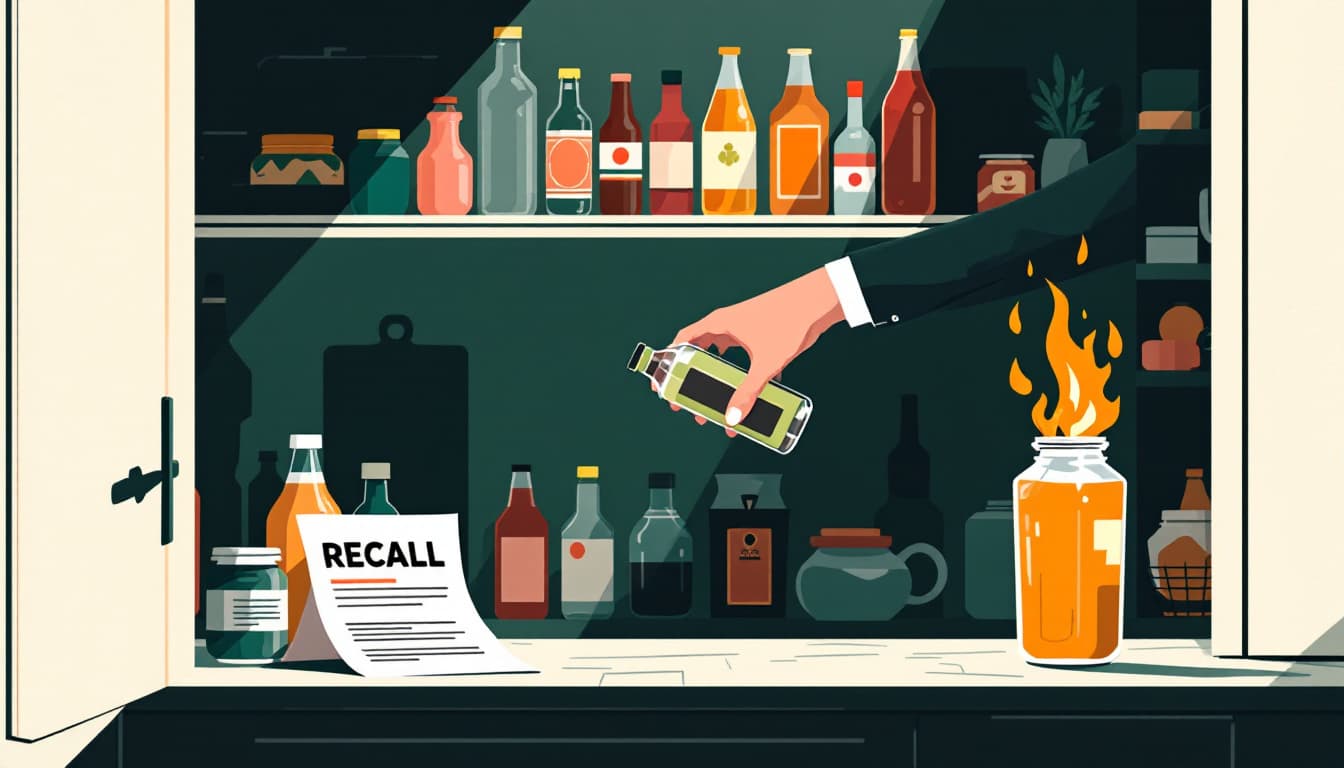
A specialty beverage recall covering 25 states, including Louisiana, surfaced this week in a report from WNTZ-TV FOX 48. The details were sparse — possible contamination, a wide distribution footprint — which is precisely when households make the most mistakes: either ignoring it entirely or tossing products that weren't actually involved.
Here is what the recall structure actually tells you, and what Louisiana families should do about it.
What's actually happening
Multi-state food and beverage recalls in the U.S. are coordinated through the FDA or USDA depending on the product category. When a recall is announced, the agency posts the specific lot codes, UPC numbers, and best-by dates on its website. That detail almost never makes it into the local TV segment — which is why the WNTZ report, like most local recall coverage, functions as an alert to go look, not a complete answer.
"Possible contamination" in recall language covers a wide range: undeclared allergens, microbial contamination, foreign material, or chemical residue. Each carries a different actual risk level. The FDA assigns Class I, II, and III designations — Class I means there is a reasonable probability of serious harm; Class III means the product is unlikely to cause harm at all. Local coverage rarely specifies the class, so checking the primary source matters.
Louisiana households face one compounding factor that most of the other 24 states in this recall don't: heat and humidity accelerate certain contamination risks, particularly microbial ones, and products that sat on a loading dock in July in Baton Rouge or Lake Charles did not have the same journey as the same product shipped to Minnesota. That doesn't change whether your specific lot is recalled. It does mean Louisiana consumers have slightly less margin for error when a recall involves spoilage pathogens.
What we'd actually do
Check the FDA's recall database directly before doing anything else. Go to fda.gov/safety/recalls-market-withdrawals-safety-alerts and search by product category or company name. You want the lot code and UPC on your actual bottle or can, compared against the numbers listed. Do not throw anything away — or keep drinking anything — based solely on a local TV headline.
The FDA database is searchable and updated within hours of an announcement. If you cannot find the recall listing there, check the USDA's Food Safety and Inspection Service site (fsis.usda.gov) — some beverages with added protein or meal-replacement ingredients fall under USDA jurisdiction instead.
Photograph the product label before returning or discarding it. Louisiana consumers are entitled to a refund or replacement on recalled products. Most retailers will process the return without a receipt if the item is on an active recall list. Your photo is documentation if there's any dispute. Some recalls also include a company reimbursement hotline — the FDA listing will include that number.
Set up FDA recall alerts so you're not depending on local TV. The FDA offers a free email subscription service for recall notices by product category. Sign up at fda.gov/safety/fdas-recall-enterprise-system. Takes three minutes. If you buy specialty beverages — kombucha, functional waters, protein drinks, cold-brew concentrates — subscribe to the beverages and dietary supplements categories specifically.
Use this as a prompt to audit your pantry storage conditions. Louisiana summers turn pantry shelves into warm-storage environments faster than most households expect. Products rated for "room temperature" storage were tested at 70°F, not the 85°F that an interior pantry in a Metairie or Shreveport home hits by June. Move beverages and canned goods to the coolest interior location you have. Under a kitchen island, in an interior closet near the floor, or in a basement if you have one — which, granted, is rare south of Alexandria.
The bigger picture
Recalls are not rare. The FDA processes hundreds per year across all food categories. What makes them worth paying attention to is not that the food supply is unusually dangerous — it isn't — but that the gap between when a recall is issued and when a household actually acts on it is often measured in days or weeks. That gap is where the actual risk lives.
The goal for a Louisiana household isn't to be alarmed every time a local affiliate runs a recall segment. It's to have a fifteen-minute process — check the lot code, check the FDA site, photograph the label, return or discard if warranted — that you can run without drama whenever one of these lands. Durable households are not the ones who panic. They're the ones who already know what to do.