The Oregon Department of Environmental Quality's AirNow monitoring network lit up last week across Central Oregon and the southern Cascades, with smoke from regional fires pushing Air Quality Index readings into the "Unhealthy" range — the 151-200 band where even healthy adults should limit outdoor exertion. Boise got the national headline: an Idaho Statesman report this week described what wildfire smoke does to your cardiovascular and respiratory systems in detail, using this summer's air crisis there as the case study. But Boise and Bend are 350 miles apart, share the same smoke transport corridor, and Oregon households are staring at the same hazard with the same incomplete plan most families have.
What's actually happening in Oregon right now
Willamette Valley residents often think of smoke as a Central Oregon or southern-Oregon problem. It isn't. The marine layer that keeps Portland green also traps smoke when it arrives. When the Cascades burn and the wind shifts east-to-west, Portland, Salem, and Eugene can hit AQI 150+ within hours. The valley's bowl geography holds smoke in the same way it holds morning fog — except fog doesn't inflame your bronchioles.
PM2.5 — particulate matter smaller than 2.5 microns — is what kills. These particles slip past nasal passages and lodge in lung tissue, triggering inflammation that within hours raises blood pressure and cardiac stress. The Idaho Statesman's reporting on this summer's Boise event underscores what cardiologists have documented in peer-reviewed research: the risk isn't just for people with asthma. Healthy people who exercise outdoors during an orange or red AQI event experience measurable short-term cardiovascular stress. Children and the elderly absorb greater doses relative to body mass.
Oregon's fire season has extended at both ends of the calendar over the past decade. The state's largest recorded fires have mostly come after 2017. The question for a household isn't whether smoke will arrive — it's whether the house is ready to be a refuge when it does.
What we'd actually do
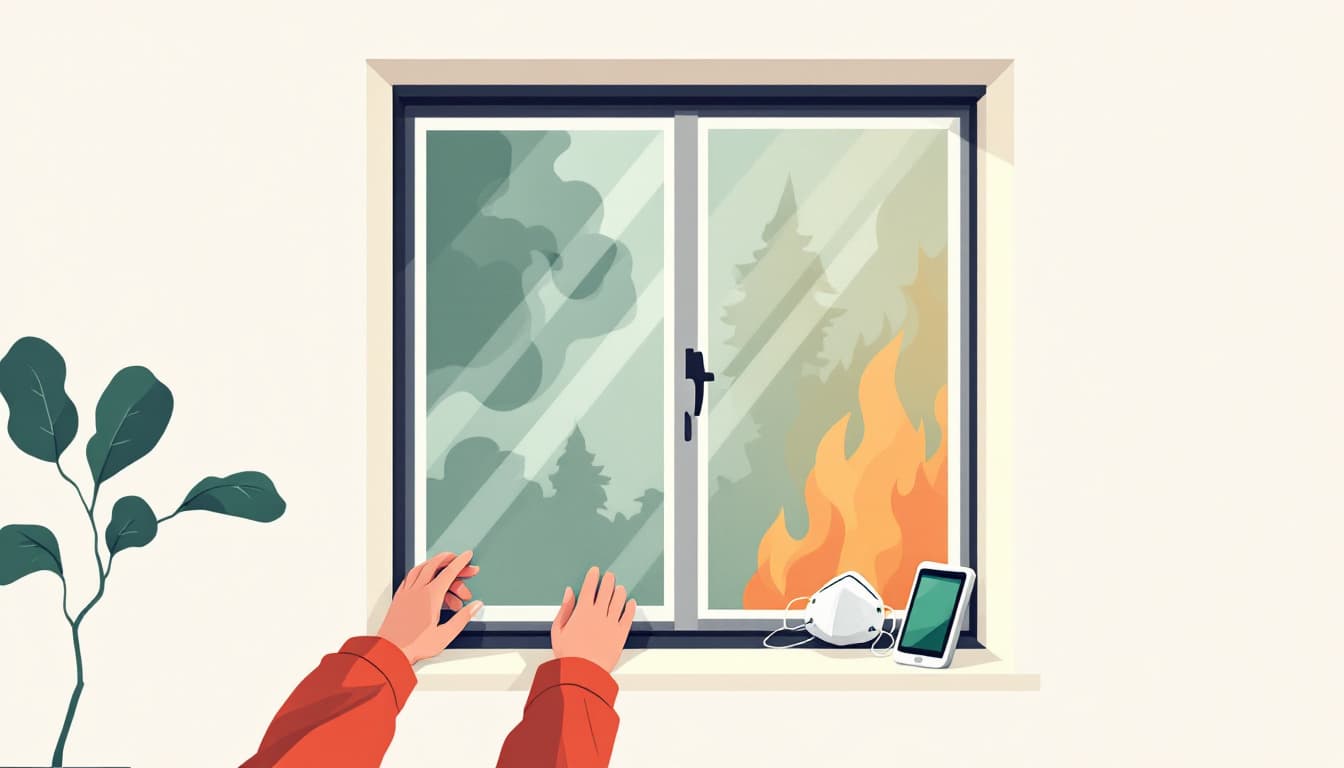
Seal one room now, before the next red-flag day. Pick the room where your family spends the most time — typically the main living area — and identify its leaks: door gaps, window frames, fireplace dampers. A $6 roll of painter's tape and a damp towel at the door threshold won't make a room airtight, but they reduce particle infiltration meaningfully. Do this drill in the next week, not during the emergency.
Run your HVAC on recirculate, not fresh-air intake, during smoke events. Most Oregon homes built before 2010 default to pulling outside air. Check your thermostat or air handler for the recirculate toggle. If your system lacks one, a MERV-13 filter in the return duct catches a significant fraction of PM2.5 — confirm your unit can handle that filter's resistance before buying. MERV-8 is standard; MERV-13 is a meaningful upgrade.
Build a DIY Corsi-Rosenthal box before August. A box fan, four MERV-13 furnace filters, and cardboard form a room air cleaner that Oregon fire researchers and public health departments have recommended publicly since the 2020 fire season. Total cost: under $80. It outperforms many $200 commercial units in head-to-head particle reduction tests. Instructions are freely available from the University of California Davis and have been shared by Oregon Health Authority. This is the single highest-impact, lowest-cost step on this list.
Stock N95s in a known location, and know how to fit-check them. An N95 worn loosely around the chin filters almost nothing. A proper seal — pinch the nose wire, pull the straps behind the head, not the ears — cuts PM2.5 exposure dramatically. Buy NIOSH-approved N95s, keep a box of 10 per adult household member, and store them somewhere you'll find them at 6 a.m. when AQI is already climbing. Surgical masks and cloth masks do not filter PM2.5.
Set an AQI alert on your phone using OregonAir, not just the weather app. Oregon DEQ operates real-time monitoring stations across the state. The OregonAir app (and airnow.gov) lets you set push notifications at specific AQI thresholds. A threshold of 100 gives you lead time to close windows and shift plans before the air becomes genuinely harmful. Most weather apps aggregate or lag this data.
The bigger picture
Smoke preparedness is not a survivalist project. It's basic infrastructure maintenance for living in the Pacific Northwest in the 2020s. The families who handle smoke seasons best are not the ones with the most gear — they're the ones who thought about this during a week in late July when there was nothing urgent happening. That's now.
Oregon's smoke risk varies enormously by county and elevation. Klamath Falls is not Portland is not Astoria. But the PM2.5 physics are the same, the health risks are the same, and the household interventions are the same. Start with the room seal. Add the box fan filter. Know your AQI threshold. That's a complete, affordable smoke plan for most families — no bunker required.