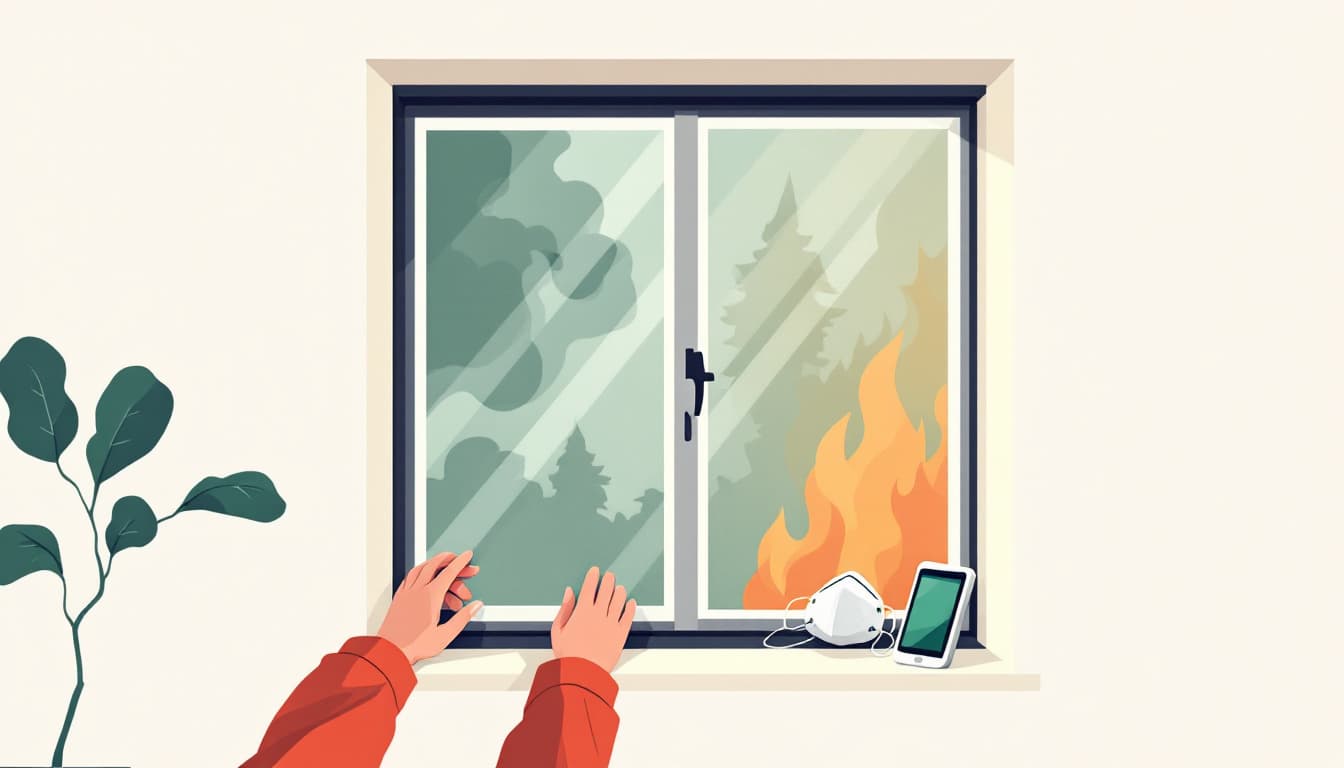
Lane County declared a wildfire smoke preparedness week starting June 1. KEZI covered the announcement without much friction — it's the kind of public health calendar item that gets a brief and a share and then disappears. What it actually signals is worth slowing down for.
Oregon's fire season no longer waits for August. The Cascade Range, the Rogue Valley, the Willamette's eastern edge — smoke from fires burning in any of those corridors, or drifting in from Northern California and eastern Oregon, can push air quality into the unhealthy range for days at a stretch. Eugene and the broader Lane County area sit in a valley that traps smoke efficiently. When AQI climbs past 150, the difference between a prepared household and an unprepared one is measurable in respiratory health, sleep quality, and the ability to keep working and caring for kids.
What's actually changing
The preparedness week is not a drill for a theoretical future. Oregon's Department of Forestry and OEM have both shifted their public messaging earlier in the calendar year — not because things are necessarily worse than last year, but because households that wait until smoke is already visible make worse decisions under time pressure. Filters sell out. N95s disappear from pharmacy shelves. Window-sealing tape is gone from hardware stores within 48 hours of a bad smoke event, as anyone who was in the Willamette Valley during the 2020 Labor Day fires can confirm.
The other thing Lane County's announcement highlights, without saying it plainly: most Oregon homes are not built to resist smoke infiltration. Older bungalows in Eugene's south hills, farmhouses in the Coast Range foothills, manufactured homes across the valley — they leak air at rates that render outdoor AQI readings almost directly translatable to indoor air quality within a few hours of sustained smoke. A well-sealed modern home with a decent HVAC filter buys you meaningful time. Most Oregon homes are not that.
What we'd actually do
Get your filter situation sorted before the first smoke advisory of the season, not during it. A MERV-13 filter sized for your furnace or air handler costs $15–$30 and cuts fine particulate matter meaningfully. If you have a forced-air system, check your filter size, order two spares, and swap one in now. If you don't have central air, a box fan and a 20x20 MERV-13 filter taped to the intake side — the "Corsi-Rosenthal" configuration — is a well-documented, sub-$50 solution that reduces indoor PM2.5. Oregon State University Extension has published guidance on this.
Identify your household's clean room before you need one. Pick one room with the fewest windows and exterior doors. This is where young children, elderly family members, and anyone with asthma or COPD will spend time during a multi-day smoke event. Stock it with a portable air purifier if budget allows; if not, use the box-fan filter rig. Having this decided in advance means you don't spend day two of a smoke event arguing about logistics while everyone's eyes are burning.
Get N95s now, not from the gas station. Hardware stores carry 3M or Honeywell N95 respirators in small quantities year-round. Two to four per adult in your household is a reasonable minimum. Surgical masks and cloth masks do not filter PM2.5 effectively — this is not contested. If you have kids, look for child-sized N95s or KN95s; fit matters.
Check your air quality sources before the season heats up. AirNow.gov is the standard, but OregonAIRS (operated through Oregon DEQ) gives you monitoring station data specific to your county. Lane, Jackson, Josephine, and Douglas counties have had some of the most acute smoke exposure in recent years. Bookmark the DEQ site. Set up a free alert if your local station supports it.
Talk to your landlord if you rent. Oregon renters are in a structurally harder position during smoke events — they often can't install HVAC upgrades or seal windows permanently. But you can ask your landlord about filter grades, request that weatherstripping be checked before summer, and document the conversation. It costs nothing and sometimes works.
The bigger picture
Lane County's preparedness week is a small, sensible nudge. The goal isn't to build a bunker or evacuate at the first smell of smoke. It's to make sure your household isn't improvising when air quality drops and stores are stripped. Oregon's fire season is long enough now that treating smoke as a recurring seasonal condition — like ice storms in the gorge or flooding in the coast range — is the accurate framing. You plan for those. Plan for this.
Durable households aren't ones that never face disruption. They're ones that have already made the $30 decisions before disruption arrives.