A WZTV report this week placed Middle Tennessee under a heat advisory running through Sunday, with the heat index forecast to reach 109°F in the Nashville corridor and surrounding counties. That number is not a temperature — it is how hot the air feels when humidity is folded in, and it is the number that determines whether your body can shed heat fast enough to stay alive.
At 109°F heat index, the National Weather Service classifies conditions as "dangerous." Heat cramps and heat exhaustion become likely with prolonged exposure. Heat stroke is possible. Those are medical classifications, not rhetorical ones.
What's actually different at this threshold
Tennessee summers are consistently hot, and most households have developed informal tolerance for heat advisories. That familiarity is a risk factor.
The physiological line that matters is whether your core body temperature is rising faster than sweat and convection can cool it. Outdoor workers in direct sun, elderly residents in homes with window units running on aging circuits, and children left in parked vehicles all lose that race faster than they expect. Recent CDC surveillance data on heat-related illness consistently shows that most victims were not engaged in strenuous activity — they were simply inside a space that was warmer than their body could manage.
Middle Tennessee compounds this with humidity. Nashville regularly sits at 60-70% relative humidity during August heat events. That moisture reduces sweat evaporation efficiency, which is the only passive cooling mechanism the body has.
A second pressure this week: power demand. When Middle Tennessee hits heat events of this magnitude, TVA and local distributors — including Nashville Electric Service and several rural co-ops — face grid stress during afternoon peak hours, roughly 3 to 7 p.m. Outages during those windows are not guaranteed, but they are meaningfully more likely than baseline. A home that loses AC at 4 p.m. with a 109-degree heat index will become dangerous in under two hours for vulnerable occupants.
What we'd actually do
Map every vulnerable person in your immediate network before noon today. Identify the elderly neighbors, the family members with cardiovascular conditions, the households with window units on aging wiring. You cannot help people you haven't thought about until they're in crisis. Make a list of three or four specific names and contact each one by text or phone.
Checking in is not just social courtesy during a 109°F event — it is the intervention that prevents the outcome. Most heat deaths in the U.S. happen to people who were isolated for 24 to 48 hours before anyone noticed. Tennessee has a robust network of county cooling centers (most county health departments and public libraries open as cooling sites during advisories), but someone has to get the vulnerable person to the location.
Lower your home's thermal load before the heat peaks, not after. Close blinds and curtains on south- and west-facing windows by 9 a.m. Run your AC between 5 and 10 a.m. to pre-cool the structure, then raise the thermostat slightly during afternoon peak hours to reduce grid stress and protect your unit from working continuously at maximum load. A house that starts the day at 72°F takes far longer to become dangerous after an outage than one that was already struggling at 78°F.
Fill three or four one-gallon jugs with water and put them in the freezer tonight. This is a two-hour power outage strategy. Frozen jugs placed in front of a box fan — or simply in a room — extend livable conditions by one to two hours, which is often enough time for grid power to restore or for you to make a decision about leaving. This costs nothing if you already have freezer space.
Identify your nearest 24-hour air-conditioned facility and drive the route once. Know exactly where you'd go if your power went out at 11 p.m. and stayed out. Walmart Supercenters, hospitals, and some 24-hour gyms are options. For households with elderly members, this is not a hypothetical — it is a decision you want made in advance, not at 2 a.m. in a house that's risen to 88°F indoors.
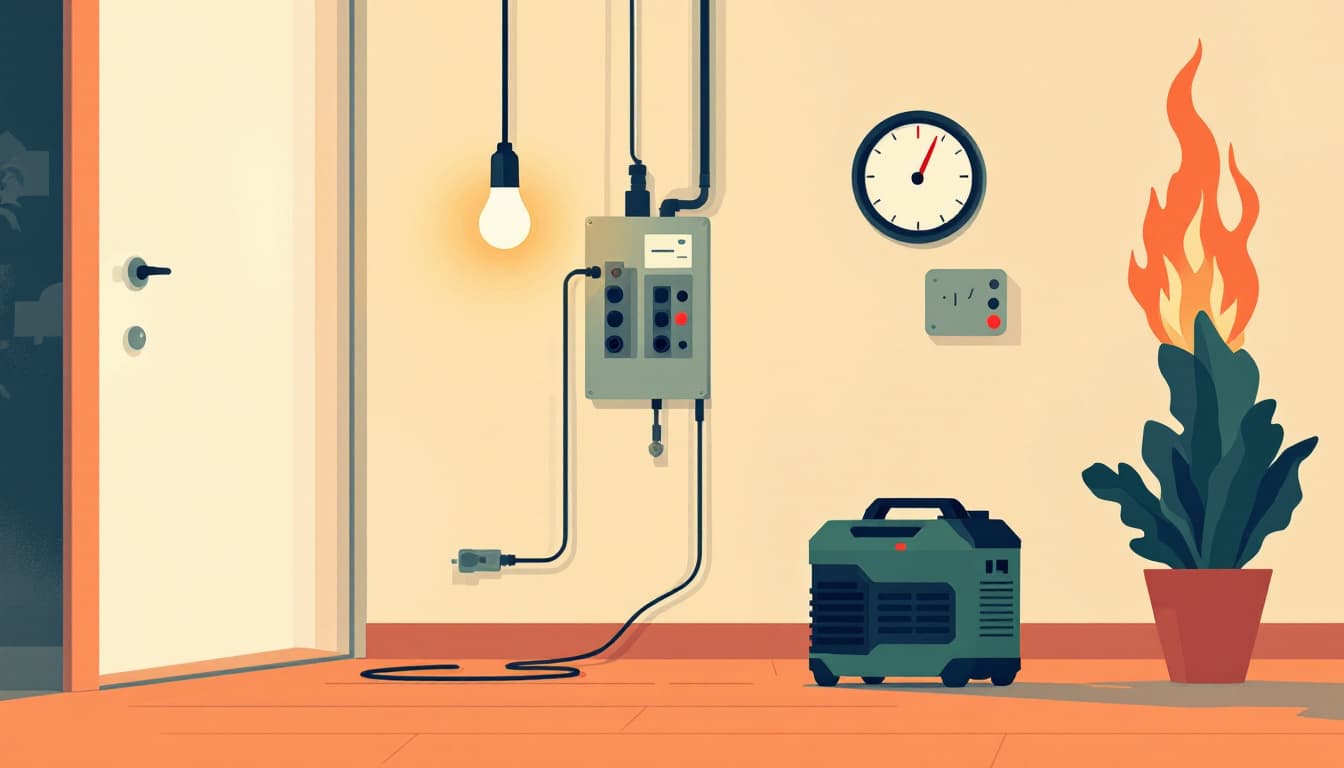
If you lose power and have a generator, run it outside and away from windows — not in a garage, not on a covered porch. Carbon monoxide poisoning spikes during heat events because people compromise on placement. Tennessee poison control and local fire departments respond to this pattern every summer. The generator buys you AC or a fan; it does not buy you much if the exhaust enters the living space.
The bigger point
Heat events are the most lethal weather phenomenon in the United States by annual death toll, and they consistently kill people who considered themselves prepared because they'd survived previous summers. The preparation that matters here is social and logistical, not gear-based. Know your neighbors. Pre-cool your home. Have a destination.
Middle Tennessee will get through Sunday. The goal is that your household — and the households around you — does so without a medical emergency that was preventable with a phone call made Thursday morning.