A WAFF report this week documented flash flooding closing roads across the Tennessee Valley — the kind of event that reads as a minor traffic inconvenience until you're the household that can't get out, can't get help in, and has no idea how long either condition will last.
The Tennessee Valley is not flat. It is a system of narrow hollows, ridge-and-valley terrain, and river corridors that funnel rainfall fast. The Tennessee River and its tributaries — the Clinch, the Holston, the Duck, the Elk — can rise in hours, not days. When roads close, they don't close one at a time. They close in clusters, because the same storm that floods Highway 72 near Rogersville is flooding the county road behind your subdivision at the same moment.
What's actually changing
Flash flooding in the Southeast has always been a seasonal fact. What has shifted is the rainfall intensity. Recent data from NOAA's precipitation frequency studies show that short-duration, high-intensity rain events are occurring more frequently across the mid-South, meaning the same drainage infrastructure faces heavier loads than it was designed for. The TVA operates an extensive reservoir system that provides some flood buffering, but that system cannot absorb every event — and it was not designed to protect roads and low-lying neighborhoods from localized cloudburst flooding.
The practical household implication: a flood watch that felt manageable a decade ago may now produce road closures that were not expected at that warning level. The Tennessee Emergency Management Agency publishes real-time flood information, but their alerts are area-wide. Your road may be impassable before any official notification reaches your phone.
There is also a compounding factor. Many Tennessee households — particularly in rural Appalachian counties and in fast-growing suburban corridors outside Nashville, Knoxville, and Chattanooga — are located on roads with only one or two exit points. When those roads flood, the neighborhood is isolated. That is not a catastrophe. It is an inconvenience that becomes a problem if anyone inside needs medication, dialysis, or emergency medical care, or if the power goes out and no one can charge anything.
What we'd actually do
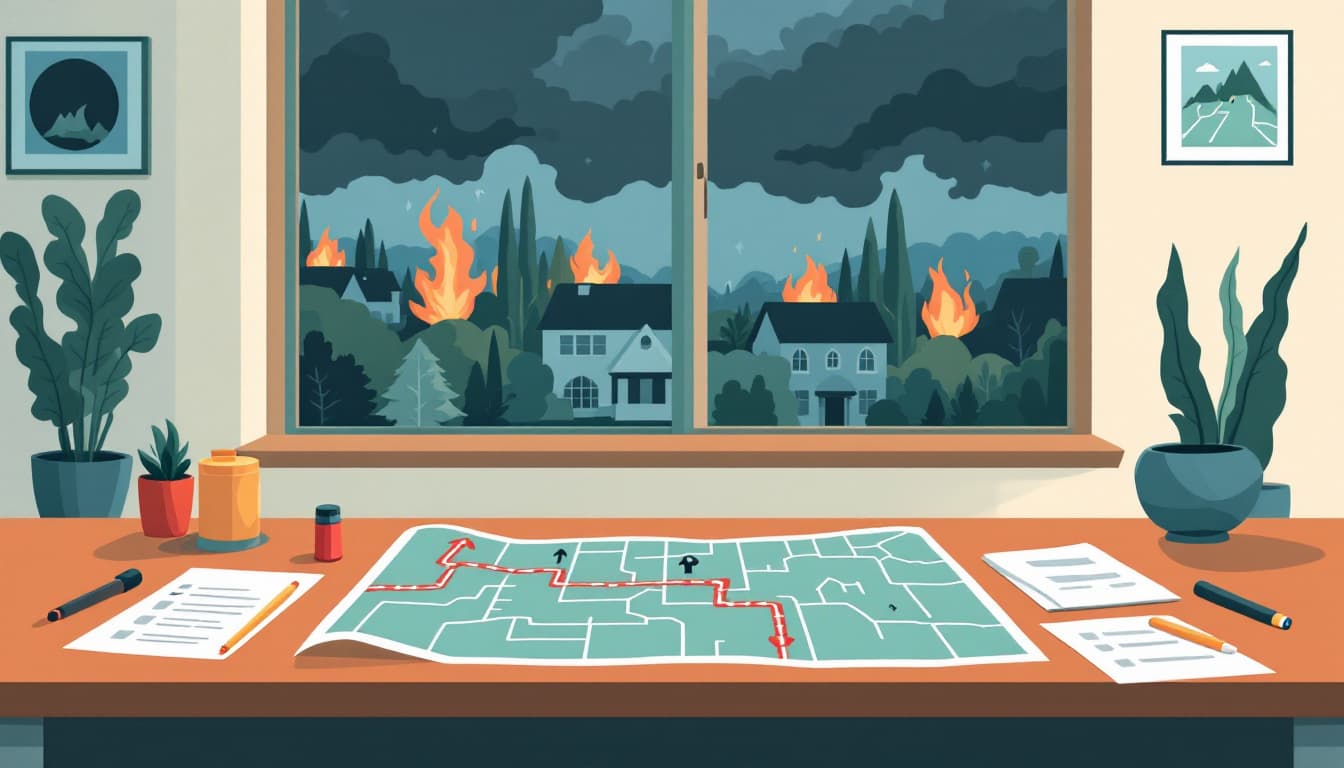
Map your exits now, before the rain. Pull up your address in Google Maps or a USGS topo viewer and count how many distinct routes leave your property to a paved road that does not cross a low-water bridge or creek culvert. Low-water crossings in Tennessee are marked on county road maps but not always on consumer navigation apps — TDOT's regional offices maintain these records, and your county highway department can tell you which roads in your area flood first. Do this on a dry afternoon so you're not learning it at midnight in June.
Set a household trigger, not a watch-and-wait policy. "We'll decide when it gets bad" is how families get stuck. A better rule: if the National Weather Service issues a Flash Flood Warning (not a Watch — a Warning) for your county, you have already decided to check your exits and top off the gas tank. Warnings in Tennessee can precede road closures by 30 minutes or less in fast-draining terrain. The NWS Memphis, Nashville, Morristown, and Huntsville forecast offices all cover different parts of the state — know which office covers your county and bookmark their page.
Keep three days of medication and a paper map in the car. A road closure that lasts four to eight hours is the most common flash flood outcome in Tennessee. That is long enough to miss a prescription refill, a dialysis appointment, or a hospital visit. A paper county map — not a phone — works when cell towers are overloaded or power is out. Tennessee county road maps are available free from most county highway departments and from TDOT district offices.
Charge everything when the watch goes up, not when the warning comes. Phones, battery banks, and medical devices. Flash flooding frequently precedes power outages because the same water that floods roads also undermines utility poles and substations. A full charge before the storm is worth more than a generator you haven't tested since March.
Know your flood insurance status. Standard homeowner's insurance in Tennessee does not cover flood damage. The National Flood Insurance Program (NFIP) requires a 30-day waiting period before a new policy takes effect, which means you cannot buy it the day before a storm. If you live near any mapped floodplain — and in the Tennessee Valley, many more properties are adjacent to one than people realize — check FEMA's Flood Map Service Center against your address.
Flash flooding in Tennessee is not a crisis. It is a recurring seasonal condition with predictable consequences for households that haven't thought through their logistics in advance. The WAFF report this week will be forgotten by the weekend. The households that use it as a 30-minute planning exercise will be more durable come August, when the next round of convective storms rolls up the valley.
Durability is the goal. Not stockpiling, not bunkers — just fewer surprises.