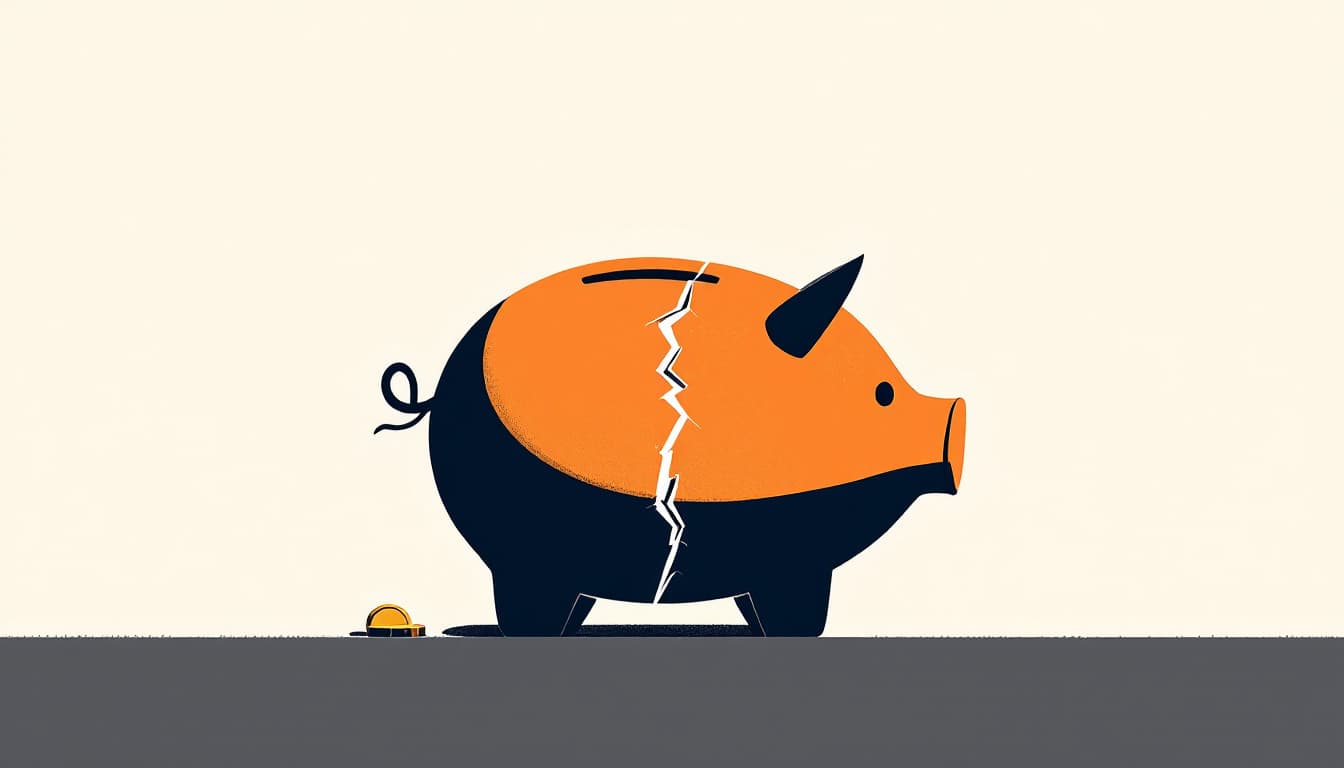
A neighbor keeps $1,200 in a savings account labeled "EMERGENCY ONLY — DO NOT TOUCH." She has kept it there, untouched, for four years. Last winter her furnace needed a $400 repair. She put it on a credit card. The emergency fund, she explained, was for emergencies.
This is not a story about financial irresponsibility. It is a story about how the standard framing of emergency savings quietly destroys its own usefulness.
The deprivation model and why it backfires
The conventional wisdom goes like this: park three to six months of expenses in a savings account, label it off-limits, and feel secure. The security is supposed to come from the size of the number and the psychological lock you've placed on it.
The problem is that a fund you're psychologically forbidden from touching is not a liquidity buffer — it's a reliquary. It sits there generating mild anxiety instead of functioning as a dynamic tool. When a real but modest disruption arrives — a car repair, a medical copay, a lost week of freelance income — people route around the fund rather than use it, because using it feels like failure. The credit card fills the gap. The fund stays "intact." The household is worse off.
The resilience framing inverts this entirely.
Liquidity as a utility, not a reward
Think about your home's circuit breaker panel. It is not there for catastrophes. It is there for the ordinary surges and faults that happen in any system over time. You trip a breaker, you reset it. The panel did its job. You do not feel ashamed that you needed it.
A household liquidity buffer works the same way. Its purpose is to absorb the normal variance in household cash flow without forcing you into high-cost debt. A $400 furnace repair is exactly what it is for. So is a $600 vet bill. So is a $900 month where your hours got cut.
Under this model, using the buffer is not failure — it is the buffer working. The discipline is not "never touch it" but rather "replenish it promptly after you use it." That is a fundamentally different psychological contract, and it produces better outcomes because households actually deploy the resource when it would help them.
Why the three-to-six-month rule deserves skepticism
The three-to-six-month figure has been passed around so long it has acquired the status of physical law. It has some merit as a rough target, but it flattens important variation.
A household with two earners in different industries, no consumer debt, and stable housing costs needs a different buffer than a self-employed single parent with a variable-rate mortgage. Recent BLS data on household income volatility consistently shows that lower-income households experience larger proportional income swings — which argues for a larger buffer, not a smaller one, precisely when building one is hardest.
More useful than a month-count target is a cash-flow analysis: look at your last twelve months of bank statements and identify the three or four largest unplanned expenses. That number — your actual historical variance — is a more honest anchor for your target than any rule of thumb.
For most middle-class households, that analysis lands somewhere between $2,500 and $6,000. Not three months of expenses. A real number tied to real history.
What to do this week
Run the twelve-month variance audit. Pull your last twelve months of bank and credit card statements. Identify every expense that was not in your regular monthly budget — car repairs, medical bills, home maintenance, irregular insurance payments. Add them up. That total is your buffer target floor.
Rename the account. Seriously. "EMERGENCY ONLY" primes you to avoid it. "Cash Flow Buffer" or "Variance Reserve" signals function, not prohibition.
Set a replenishment rule, not a no-touch rule. Decide now: if you draw the buffer below a certain threshold, you will direct a fixed dollar amount from your next three paychecks to rebuild it. Write this down somewhere you'll see it.
Separate the buffer from the catastrophe fund. If you want a larger reserve for genuine income-replacement scenarios (job loss, major illness), keep that in a separate account. Don't let the two purposes contaminate each other.
The bigger picture
Resilience in household finance is not about hoarding money or living in fear of what might happen. It is about building systems that allow normal life to continue when normal variance occurs — because variance always occurs. The household that can absorb a $400 furnace repair without going to the credit card is more resilient than one with a larger "emergency" fund it can never bring itself to use.
The circuit breaker exists to trip. The buffer exists to be drawn. That is not a sign the system is failing. That is the system working exactly as designed.