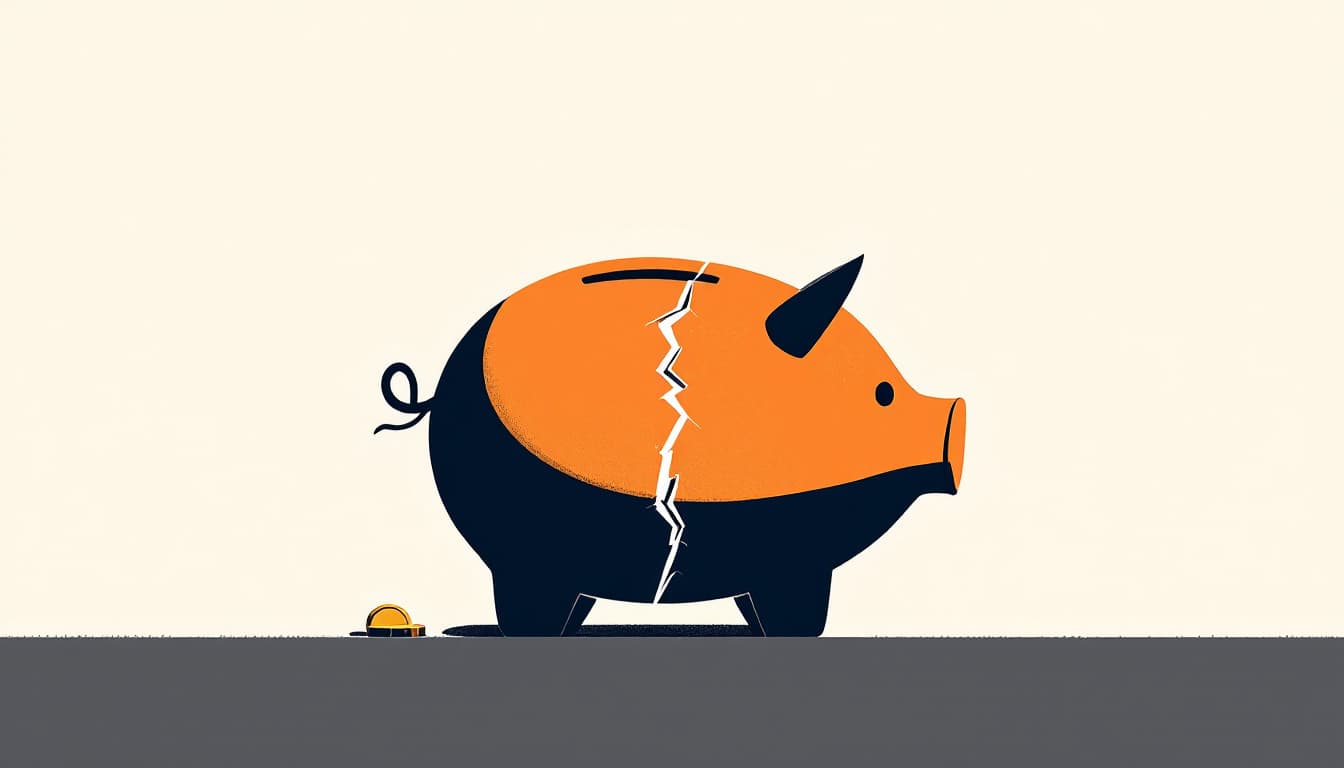
Somewhere between the gym membership you use twice a month and the cloud storage tier you upgraded during a photo emergency three years ago, your household's emergency resilience quietly eroded. Not dramatically. No single line item did it. That's exactly the problem.
The math most preparedness frameworks skip
Emergency planning tends to focus on the numerator: how much money do you have in reserve? Three months of expenses. Six months. The denominator — what "one month of expenses" actually is — gets estimated rather than measured, and the estimates are almost always low.
Recent consumer finance surveys consistently show that households underestimate their monthly fixed outflows by somewhere in the range of 15–25 percent. For a household with $3,000 in monthly fixed costs, that's a $450–$750 gap between the number they're carrying in their head and the number that will hit their bank account if income drops to zero next Thursday.
The culprit is not lavish spending. It's the structure of modern billing. Subscriptions are engineered to be invisible: annual renewals that don't appear on your monthly mental ledger, per-user tiers that crept up when a family member was added, services bundled into a credit card benefit that became a standalone charge when you switched cards. None of these are catastrophic. Together, they constitute a slow leak in the hull of your financial preparedness.
Why this is specifically a resilience problem, not just a budgeting problem
A budgeting problem is about optimization — you'd like to spend less on things you don't value. A resilience problem is about system failure under stress. Here's the distinction:
When your income drops suddenly — a job loss, a medical event, a business disruption — you make triage decisions. You rank your obligations by urgency and cut what you can. The problem with subscription creep is that it inflates the number of line items you have to identify, evaluate, and cancel under pressure, at the exact moment when cognitive bandwidth is lowest.
A household with 22 recurring charges needs to make 22 decisions. A household with 9 recurring charges needs to make 9. The difference isn't just the dollars; it's the decision load at a bad time.
There's also a timing trap. Many subscription services require 30 days' notice or bill one cycle ahead. If you don't catch and cancel a service in the first week of a financial disruption, you've already committed to another month of that charge. Multiply that across several services and you've lost $150–$300 of runway you thought you had.
The number you should actually know
Your "true floor" — the minimum your household requires each month if every optional and semi-optional charge is eliminated — is a more useful preparedness number than your average monthly spending.
Most households have never calculated it. They know their mortgage or rent, their car payment, their utilities at an average figure. But they don't have a single number for what life costs if everything non-essential goes dark on the same day.
That number is what your emergency fund should actually be measured against, not your comfortable-times spending. If you have $9,000 in emergency savings and your true floor is $3,800/month rather than the $3,200 you estimated, you don't have three months of coverage — you have closer to two and a half. Not a disaster, but a meaningful difference in the decisions you'd face in month three.
What to do this week
Step one: Pull every recurring charge from the last 90 days. Use your bank statement and your credit card statement. Don't rely on memory or a mental list. Write them down in a single place — a spreadsheet row per charge, with the amount, billing cycle (monthly/annual), and which account it hits.
Step two: Categorize ruthlessly as Essential, Useful, or Nice-to-Have. Essential: utilities, insurance, mortgage/rent, phone. Useful: things you'd genuinely miss and that serve a functional purpose. Nice-to-Have: everything else.
Step three: Calculate your true floor. Sum only the Essential column. This is your resilience baseline — the number that tells you what one month of survival actually costs your household.
Step four: Set a cancellation threshold. Decide now, not under pressure, that if household income drops by X percent, the Nice-to-Have column goes dark immediately, no individual deliberation required. Make it a policy, not a decision.
This whole exercise takes about 90 minutes. It is not exciting. It will almost certainly surface $80–$200 in charges you'd forgotten about, which is a nice bonus. But the real return is knowing your true floor before you need it.
The bigger picture
Preparedness culture spends enormous energy on gear, supplies, and skills. Those things matter. But the financial layer — specifically the cash-flow layer, not just the savings balance — determines whether a household can deploy any of that preparation or whether it gets swamped in the first 60 days of a disruption.
Subscription creep is a small force working against you every month. It's not a crisis. It's not worth panicking about. It is worth understanding precisely, because precision is what lets you hold your ground when something larger goes wrong.
Know your floor. That's where resilience starts.