
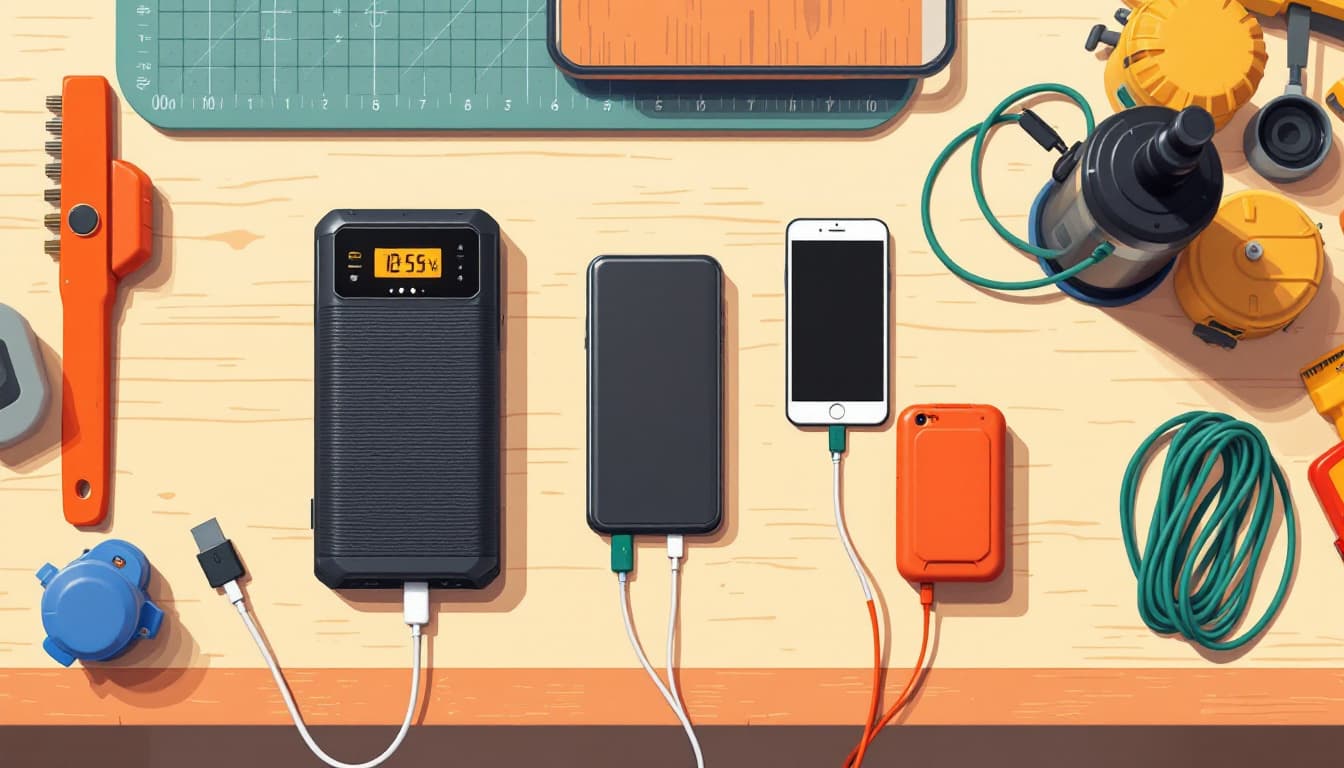
Why a battery bank is the highest-leverage power purchase most households make
There is a strange gap in most household preparedness setups. Plenty of families have thought about a portable power station — the 1,000Wh-and-up class that runs a refrigerator — and plenty have a drawer full of AA batteries. Almost nobody has deliberately thought about the layer in between: the USB battery bank that keeps phones, tablets, headlamps, and small medical devices running.
That's backwards. In a realistic multi-day outage, the phone is the single most important device in the house. It's the weather radio, the flashlight, the family communication channel, the utility-outage map, and the camera you document damage with for an insurance claim. A $42 battery bank keeps that device alive for three or four days. A $500 power station does the same job, plus the refrigerator, at twelve times the price and thirty times the weight.
Both belong in a well-built household. But if you own neither, the bank comes first. It is the cheapest meaningful step from "our preparedness plan collapses when the phones die" to "it doesn't."
What actually matters when you're choosing
Watt-hours, not milliamp-hours. The mAh number on the box is measured at the cell's internal voltage (usually 3.7V), not the 5V your phone actually receives. After conversion losses, a 20,000mAh bank delivers roughly 13,000–14,000mAh of usable charge. Watt-hours (Wh) is the honest unit, and it's the one airlines use: the 100Wh carry-on ceiling is why the best banks in this class cluster around 24,000–27,000mAh rather than going bigger. Every pick here is flight-legal.
USB-C Power Delivery wattage decides what you can charge. A 22.5W bank charges phones. A 65W bank charges most laptops. A 100W-per-port bank charges a demanding laptop at full speed while also feeding a tablet. This is the single spec that separates the three tiers here, and it's the one to match against what your household actually owns.
Trickle-charge mode is the preparedness feature nobody advertises. Most banks monitor draw and shut off when they see a very low current, assuming the device is full. That means they refuse to charge hearing aids, some headlamps, Bluetooth earpieces, and certain small medical accessories. Both INIU picks here have an explicit low-current mode. If anyone in your household depends on a small USB device, check for this before anything else.
Self-discharge determines whether it works when you need it. A bank stored in a go-bag and forgotten will lose charge slowly over months. This is an argument for the boring habit rather than the expensive product: top every bank in the house off twice a year. Pin it to the same weekend you check smoke-detector batteries and rotate the pantry.
Check the model number on the bank you already own. In 2025 Anker recalled roughly 481,000 PowerCore and MagGo units manufactured between 2016 and 2022 over a fire risk — affected model numbers include A1263, A1257, A1647, A1652, A1681, and A1689. The number is printed on the body of the unit. This is worth five minutes with the bank currently living in your kitchen drawer, and it is the main reason we'd replace an aging no-name bank rather than keep it as a spare.
Who each tier is actually for
Premium — Anker 25,000mAh 165W (~$105): Right for a household where someone works from home and a multi-day outage means a laptop has to stay alive, or where you want one device that covers the whole family rather than three smaller ones. The built-in retractable cables matter more than they sound: in an actual outage, the failure mode is rarely the bank, it's the missing cable. The tradeoff is weight and price — this is a bag item, not a pocket item.
Value — INIU 20,000mAh 65W (~$42): The right default for most households. It is laptop-capable, which is the capability jump that matters, while staying small enough to actually carry. If you buy one battery bank for the house, buy this one. If you buy two, buy this and the budget pick.
Budget — INIU 10,000mAh (~$21): Not a compromise so much as a different job. At this price the correct number to own is three or four: one in each vehicle, one in the go-bag if you keep one, one by the bed. It won't run a laptop and it refills slowly, but it turns a dead phone into a working phone, which is the entire point. The trickle-charge mode makes it the pick for anyone charging a hearing aid.
What we'd skip
Solar-integrated battery banks. The small panel glued to the back of a "solar power bank" produces so little current that fully recharging the bank from it takes days of direct sun. If you want solar recharging, buy a real portable solar panel and a real bank separately. The integrated version does neither job well.
Buying capacity you'll never cycle. A 40,000mAh bank is heavier, slower to recharge, illegal as airline carry-on, and — because it's annoying to carry — more likely to sit at home discharged. Two 20,000mAh banks are more useful than one 40,000mAh bank in almost every household scenario, because they can be in two places at once.
No-name banks with implausible specs. Capacity claims are effectively unregulated on marketplace listings, and the cells inside a $12 "30,000mAh" bank are the part you never see. This is a category where a known brand with a real warranty is worth the small premium — the failure mode is a fire in a drawer, not just a disappointing charge.

