
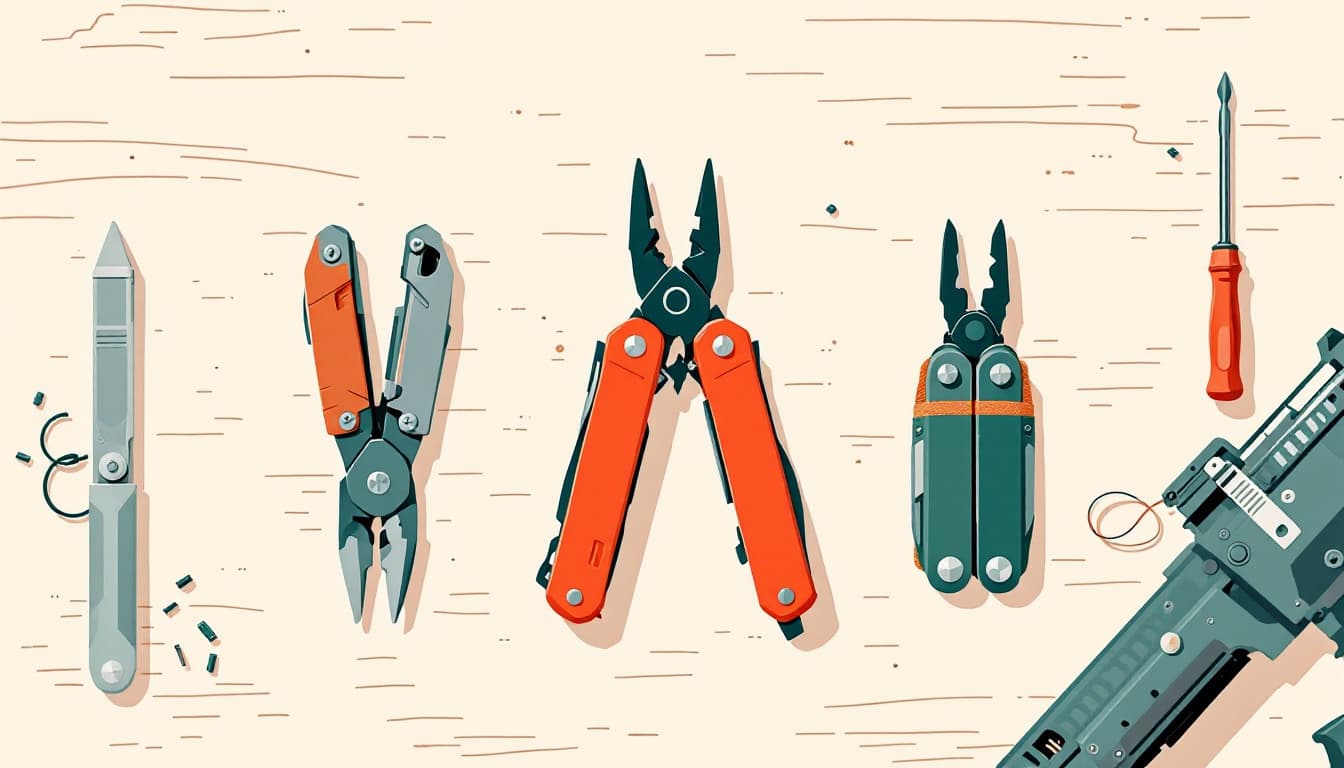
Why a multi-tool, and why this is not a tactical purchase
Search "survival multi-tool" and you will get a wall of blacked-out gear photographed on slate, sold on the premise that one day you will need to saw through a seatbelt. That framing is the reason a lot of thoughtful households skip this category entirely, and it's a shame, because the multi-tool is one of the few genuinely useful items that preparedness marketing has managed to make embarrassing.
The honest case is much more boring. A multi-tool is what you reach for when the battery compartment on a weather radio needs a screwdriver you can't find, when a hose fitting is seized, when a package needs opening and the scissors have vanished, when a wire needs stripping, or when the power is out and you need pliers now rather than after ten minutes of hunting in a dark garage. It earns its place through hundreds of small uses, not one dramatic one.
That's also why we'd put it firmly in the second tier of a household's gear priorities — after water storage, a first-aid kit, and light. It's a quality-of-life multiplier, not a life-safety item.
What actually matters when you're choosing
Access design beats tool count. This is the single most useful thing to know about the category. A tool advertising "21 functions" is not better than one advertising 14 if the blade is buried inside the handle. What matters is whether the implements you use constantly — the knife, the pliers — can be deployed quickly, ideally one-handed, without unfolding the whole tool. Leatherman's "outside-accessible" designs win here, and it's the reason both Leatherman picks beat higher-count competitors.
Replaceable wire cutters are the real durability spec. On most multi-tools, the wire cutter is a notch machined into the plier jaws. Cut something hard enough — a nail, a hardened wire — and you've permanently notched the jaws of a tool you can't repair. The Wave+ uses replaceable inserts, so that mistake costs a few dollars instead of the tool. It's the least glamorous reason to spend more and probably the best one.
Warranty length is a genuine differentiator here, not marketing. Leatherman's 25-year warranty is real and widely honored, and it changes the math: a $130 tool that gets repaired or replaced for two and a half decades is cheaper per year than a $38 tool replaced three times. Gerber's limited lifetime warranty is meaningful but narrower in practice.
Try to hold one, or buy for the hands that will use it. Full-size multi-tools have squared handles that dig into the palm under real torque. If the person most likely to use it has smaller hands, the 7 oz Sidekick is not a downgrade from the 8.5 oz Wave+ — it's the better tool, because it will actually get used.
Bit drivers are the difference between "has a screwdriver" and "is a screwdriver." A fixed flathead is nearly useless on modern hardware. A tool that accepts standard bits handles Phillips, Torx, and hex, which covers the appliance, furniture, and electronics screws in a typical house. This is the main functional gap between the premium and value picks.
A note on variants
Multi-tool listings are unusually messy. The Wave+ alone has several live listings covering black oxide finishes, MOLLE sheaths, and gift-box bundles, plus older non-Plus Wave listings that look nearly identical in thumbnails. The Sidekick and the Suspension NXT have the same problem. We've linked the canonical stainless-with-sheath listing in each case — the one a shopper would naturally land on and the one carrying the deepest review history. If you follow a link and the price looks unusually low, check whether you're looking at the older generation or a different finish before buying.
Who each tier is actually for
Premium — Leatherman Wave+ (~$130): Right for the household that wants one tool, permanently, and is done thinking about it. The replaceable cutters and bit drivers are what you're paying for, and the 25-year warranty makes the price a one-time decision rather than a recurring one. If it will live in a drawer or a bag rather than a pocket, the weight objection mostly disappears.
Value — Leatherman Sidekick (~$70): The right default. It keeps the access design and the warranty — the two things that actually matter — and drops the bit driver and replaceable cutters, which most households will never miss. Lighter, cheaper, and easier to use for anyone who finds the Wave+ chunky.
Budget — Gerber Suspension NXT (~$38): Not the tool we'd make a household's only one, but the right answer for the second and third. Put it in the glovebox and the garage, where the real value is having a tool within reach rather than the best tool two rooms away. The blade dulls faster and the pocket clip is weak, but the pliers and the outboard locking tools are honest.
What we'd skip
Credit-card and keychain "20-in-1" tools. The flat stamped-steel cards with a dozen cutouts are novelty items. The leverage is wrong, the edges are poor, and nobody has ever successfully used the bottle-opener notch on one. If you want something pocketable, a small knife with a bit driver beats any of these.
Anything sold primarily on a survival scenario. If the listing photography is more concerned with paracord and tactical sheaths than with the tools themselves, the manufacturing budget probably went the same way. The tools that hold up in a household are made by companies that sell to tradespeople.
Buying a third full-size tool instead of a socket set. At some point the multi-tool stops being the answer. If you find yourself reaching for it for real repairs weekly, the honest upgrade is a basic socket set and a decent screwdriver — not a more expensive folding compromise.

